Eight Hours Ahead
The Playground
There is a particular invisibility that isn't cruel. It doesn't announce itself. Nobody is mean to you. Nobody picks on you or calls you names. They simply don't. Don't notice. Don't ask. Don't include. You exist the way a wall exists in a familiar room. Present, but unlooked at.
Sana knew this invisibility well.
She had carried it since Standard Three. She was tall for her age. Too tall, and not in a way that promised anything graceful later. She slouched because tall felt like a problem to be apologised for, and the slouch became habit, and the habit became her. She walked through school corridors with her shoulders turned slightly inward, taking up as little space as she could manage given that she took up a great deal of it.
She had two friends. Maybe three, if you counted Prita, who shared her tiffin sometimes but wouldn't sit with her if her other friends were around.
So Sana watched instead.
She watched from the side of the playground during PT period. She stood near the water taps and watched the boys' side of the yard while everyone else ran and shrieked and made the ordinary noise of children who felt at home somewhere.
That's where she first noticed Arjun.
He was small. Noticeably small. But he moved like someone who had never been told he was small, or had been told and found the information uninteresting. He ran the fastest in their grade for three years. A compact, dark-haired boy with his shirt always half-untucked and his laces always loose, and by the end of every PT period his face would go magnificently red. Not pink. A deep, physical, thoroughgoing red that started at the tips of his ears and moved down. He never seemed embarrassed by it. He would bend his hands to his knees, pull in three hard breaths, and grin at whoever was nearest.
Sana saw all of this from across the yard.
He never once looked in her direction.
After
Time moves. It always does.
She finished school. Finished a degree in literature she wasn't entirely sure what to do with. Her parents moved. She moved further — England, London, a small flat near a bus route she had memorised in her first week and a job in publishing that surprised her by fitting. She was thirty-one by the time she had mostly stopped apologising for the height. The old slouch came back on tired evenings. A reflex from a childhood the body hadn't quite let go of.
She was not unhappy. She was the not-unhappy that feels, on Sunday afternoons with grey rain on the window, a great deal like being alone.
Arjun she knew nothing about. They had never spoken. Not once. She couldn't have said why she remembered him at all. Only that the mind keeps what it keeps, and apparently it had kept a small boy going red from the ears down on a school playground.
October
The year she turned thirty-one, she found him on Instagram.
It happened sideways. A mutual from school, a tagged photograph, a name she recognised before she'd consciously gone looking for it. Arjun. Same jawline. Older face. Something settled about him now that hadn't been there at twelve. He was in Singapore. His pictures were infrequent and said very little: a restaurant table, a harbour at dusk, his hands around a coffee cup with a laptop open beside it. No declarations. No performance.
She almost didn't message him.
She sat with it for four days.
She messaged him.
Eight Hours
It started like that. Lightly.
He messaged her three days later with a question about a book. Had she read it. Was it worth his time. She had read it. She told him yes, absolutely, and wrote four sentences about why. He replied by voice note instead of typing, and she put her earphones in on the Tube home and listened to his voice for the first time since she had last heard it across a school corridor fifteen years ago. Deeper now, and unhurried, with a small laugh at the end of a sentence where he disagreed with her on one point.
She listened to it twice.
She replied by voice note too, something she had never done with anyone, and found she didn't mind the sound of her own voice as much as she usually did.
That was the beginning of the actual thing.
They talked most days after that. Nothing frantic about it. It moved at the pace of two busy people who were, somehow, making time. He was eight hours ahead. She would message him before bed and wake to his replies. He would send voice notes in the morning Singapore time and read hers over coffee.
She told him things she hadn't told people who were physically present in her life. About the manuscript she'd been working on for two years. About her mother's hip operation and the guilt of being an ocean away for it. About the flat and the grey winters. About being tall in a world built for someone five inches shorter, and how she'd finally, mostly, stopped minding. About Tuscan, her cat — a ginger, unhurried creature she had adopted three years earlier from a shelter and named after a colour in a paint catalogue she'd been using as a bookmark — who slept on her manuscripts and regarded her laptop as a personal grievance.
He listened. Not the kind of listening that is really just waiting to speak. He sat with what she said. His questions showed he had followed the thread, held onto the details. When he spoke it was honest. Not careful, not cushioned. Just true.
He told her about Singapore. About the business he had built from scratch in a country where he knew almost nobody at the start. He was not rich yet when he arrived. He was careful with money, methodical, a worker in the truest sense. He had built something real by the time they found each other, though he never described it that way himself. She had to piece it together from small things he said without meaning to say them. He had a dog — she knew this from the background of a voice note one evening, a low woof and then the shuffle of something large being settled near the phone.
Every Sunday morning without fail, Sana drove to her parents' house. An hour each way, the same motorway, the same stretch of grey English countryside. She started calling him on those drives. Something about the motion of driving made talking easier. No eye contact required. No need to arrange your face. Just the road and his voice and the early light coming in through the windscreen.
He drove too. Most evenings after work he had a long route back, and he would call her then, Singapore evening to London afternoon. She would be eating lunch at her desk and he would be navigating through traffic, and they would talk about everything and nothing, the way people talk when they have decided they are safe with each other.
She learned the sounds of his drives. The indicator. A particular junction he mentioned often. A radio he kept low in the background that she could just barely hear. He learned the sounds of hers. The Sunday morning quiet of her voice, still half-sleepy, more honest than usual.
It was in those drives that most of the real things got said.
Shift
She didn't know exactly when it shifted.
It didn't have a date. It arrived gradually and then it was simply there, and she only recognised it looking backwards.
The voice notes had grown longer. The photographs had started. Nothing posed. Her desk in the morning light. A book left open on the floor. A wet London street she found beautiful for reasons she couldn't explain. He would send back the Singapore waterfront at evening, a coffee, once his own reflection caught in a glass door coming out of a building. She had looked at that photograph for longer than made sense.
She started choosing what she wore before sending him anything with her in it. She told herself this was unrelated to anything specific. She knew it wasn't.
He said things like: you see things differently to most people. And: I look forward to talking to you. Small things. Clean things. Nothing she could point to as a declaration. But they accumulated and they had weight.
"I've been thinking about something you said last week. About building the Singapore business from almost nothing. About how long it took. I keep coming back to it. I don't think you know what you give people when you talk like that. You say things and they stay. I just wanted to say that properly. Goodnight, eight-hours-ahead."
"Eight-hours-ahead. I've been sitting with your message for ten minutes before replying. Nobody says things like that to me. I'm not sure what to do with it. Thank you, Sana. Sleep well. You're probably already sleeping."
She had, at some point, given this man a very large piece of herself. The kind that, once given, does not come back the same way it left.
February
They fought in February.
It started small. A misread tone, a reply that came too fast and without enough care behind it. She had asked him something about his past, something she had been circling for weeks. He had answered in a way that felt like a door being quietly closed. She said something sharper than she meant to. He went quiet.
Three days of quiet. Three days of opening her phone and finding nothing and putting it back down.
They did not name what this was. Not in words. But something had been said in the space between those messages, and they both felt it, and neither stepped back from it.
Spring came. The light returning after the long grey.
She was at her desk — third draft of the manuscript, the best it had been — when his voice note came through at six in the morning his time, before he'd clearly even left home. He'd closed a deal. First one from a new territory, something he'd been building toward for nearly a year. His voice had a particular quality to it — restrained, but underneath the restraint something that sounded like a man who had kept his word to himself.
She sat up straighter and listened twice.
She pressed record: "I'm so proud of you. I want to say that properly. Not well done, not great news — I'm genuinely, unreservedly proud of you. Don't be modest about this one."
She sent it before she could think too much about the word proud and everything it contained.
He replied an hour later: "Nobody's said that to me in a long time. I didn't know I needed to hear it until just now."
Singapore
She went to Singapore in July.
She had told herself for weeks it was a work trip with an extra few days bolted on. She had told her mother the same thing. She is not sure who she thought she was convincing. She dropped Tuscan at her parents' on the way to Heathrow. Her mother took him with undisguised pleasure. Tuscan walked straight to the back of the house and refused to look at Sana as she left, which was his way of saying he knew exactly what was happening and had decided to be dignified about it.
He met her outside the airport. She had imagined this moment and now that it was here it was both exactly what she had expected and nothing like it at all. He was small, just as she remembered, and he stood with his hands in his pockets looking at her with an expression she couldn't quite read. She was a full head taller than him in her shoes. She thought, absurdly, about the playground.
They stood there for a second, both slightly uncertain, and then he said hello, and she said hello, and they laughed at how strange and ordinary it all was at once.
He had a scooter. Of course he had a scooter. He drove her through the city on it, her long frame folded behind him, her hands not quite knowing where to settle, the evening heat still sitting in the air and the city lit up around them. She had not been on a scooter in years. She held on and watched Singapore move past and said nothing for a while because she didn't need to.
He took her to a small place near where he lived. Not a restaurant exactly, more a row of open stalls, plastic chairs, cold drinks in paper cups. They sat across from each other and ate things she couldn't name and he told her what each one was called and she forgot immediately and he told her again. She ate more than she expected to. He ordered without hesitation, already knowing what she would like before she'd said.
It was good to be together. Not complicated or charged or heavy. Just good. She felt something settle in her chest that had apparently been waiting to settle for a long time.
They talked until the stalls started closing around them, the easy way they had talked on drives and in voice notes and across eight hours of ocean — only now she could see his face when he said things, and he could see hers, and that turned out to matter more than she'd known.
At some point during that first evening, without ceremony, he reached across the table and took her hand. He turned it over, pressed a brief kiss to the back of it — just a peck, quiet, without drama — and let it go. He went straight back to telling her the name of what they were eating. She looked down at her hand. Then she looked at him. He was not looking at her. He was already pointing at something at the next stall.
She said nothing. Neither did he. It was not something that needed words.
She stayed five days. They weren't together every moment. He worked. She walked the city alone with earphones in and called him in the evenings when he was done. But the few hours they had each day were enough to show her what they were without a screen between them. He was the same. Steadier in person, if anything. She liked watching him move through a place he knew well, the ease of him, the way he was comfortable with himself in a way she had never quite managed.
She met Bruno on the second day. He came to the door when Arjun let her in — a calm, solidly built dog who inspected her with methodical thoroughness before deciding she would do. He accepted a hand on his head, sat down beside her on the sofa that evening, and leaned against her leg with the undemonstrative warmth of an animal who has made up his mind. She thought, for a moment, about Tuscan at her parents' house — probably occupying her mother's reading chair and being thoroughly untroubled by her absence. The two of them would have to come to some arrangement.
On the last night he drove her again on the scooter, slower this time, through streets she was starting to recognise. She didn't want it to end. She knew it was ending. She held on a little tighter and watched the city lights and said nothing and he said nothing, and it was the clearest and most complete she had felt in longer than she could remember.
She flew home to London the next morning.
It was good to be together. Not complicated or charged or heavy. Just good. She felt something settle in her chest that had apparently been waiting to settle for a long time.
After All
The years after that were not simple.
Nothing broke. Nothing ended. But time brings its own weight, and Sana had started to feel it in a way she hadn't when they were newer to each other.
Depression arrived slowly, the way it tends to. Not dramatically. Just a heaviness that sat in her chest some mornings and didn't lift by afternoon. Days when getting up and driving to her parents' house and doing all the ordinary things required more effort than it should have. Days when she would look at her phone and know he had messaged and find herself unable to reply, not because she didn't want to but because she couldn't find the surface of herself.
She started going quiet on him at times. Not to punish him. Not out of anything rational. She would just pull back, fall into herself, answer in shorter lines or not at all for a few days, and then surface again and find him still there, still asking how she was, still patient in the way he had always been patient.
She wanted him close. That was the painful truth of it. On the bad days especially, she wanted him physically present in the way that no voice note and no phone call could fix. She wanted to sit in the same room with him and not have to explain anything. But Singapore was Singapore and London was London and that was simply how it was, and some distances cannot be closed by wanting.
So they managed.
He talked to her on his drives. She talked to him on her Sunday morning motorway. She sent him voice notes at midnight that she sometimes wasn't sure made sense. He sent her back voice notes that showed he had followed every word of it and sat with it before answering. There were weeks when they talked every day and weeks when they hardly talked at all, and each time she came back from the quiet he received her without making it into something.
"I'm on the drive. It's a grey one today. I've been quiet this week, I know. I'm sorry. I don't always have a reason. I just go under sometimes and it takes me a while to come back up. I just wanted you to know I think about you. I still think about you."
"I know you go under. I'm not going anywhere. Drive safe. Call me when you're back."
She grew older. So did he. His business grew. She finished the manuscript and it found a home and she held the published book in her hands one morning in her London flat and the first person she called was him. He answered on the second ring even though it was early in Singapore and she could hear that she had woken him up and she said sorry and he said don't be and she told him the news and he went quiet for a moment and then said: I knew. I always knew it would happen.
She sat on her kitchen floor with the book in her lap and cried a little, which she did not entirely understand, and he stayed on the line without saying anything much, which was exactly right.
One evening — it was a January, London grey and persistent outside her window — she said it out loud for the first time. Not to him. To herself, in the kitchen, waiting for the kettle. A sentence that had been forming for months without her permission:
You can write from anywhere in the world.
She had always known this. She had edited manuscripts from trains and cafes and her parents' kitchen table. The work did not require a specific postcode. It required a desk, a window, and enough quiet. She had been using the work as an excuse to stay in one place. She understood that now.
She called him that night.
She landed in Singapore on a Thursday afternoon with two suitcases and Tuscan in a carrier hanging from her shoulder. He had been vocal about the flight from the moment the cabin pressure changed and had not stopped since. She walked through arrivals with her considerable height and her bags and a ginger cat loudly registering his objections to the entire enterprise.
Arjun was waiting outside. Hands in his pockets, unhurried, exactly as before. He looked at the carrier. He looked at her. He said nothing, but the corner of his mouth moved. She said: "Don't." He said: "I didn't say anything." She said: "You were about to." He picked up one of the suitcases and they walked to the car and she didn't feel strange about any of it. She felt precisely like someone who has finally arrived somewhere she was already expected.
Back at the flat, Tuscan was released from the carrier with the wounded dignity of a cat who has been through something and intends to make it known. Bruno appeared from the other room. The two animals considered each other across the length of the hallway — Tuscan from a slight elevation on the arm of the sofa, Bruno from a seated position on the floor, head tilted, tail doing one cautious sweep. Neither of them moved for a full minute. Then Tuscan turned away with magnificent indifference and began to wash his face, which Bruno apparently decided to interpret as a verdict he could live with. He went back to his spot by the window. That was more or less that.
She and Arjun went to the harbour. His idea. They stood at the water as the city behind them moved into evening, the sky doing what Singapore skies do at dusk — turning a deep gold that softened into something quieter, the water holding the last of the light. He put his arm around her and she leaned down slightly, which she had always had to do, and they stayed like that for a long time without talking. She felt his arm tighten a little. She let herself be held.
The city went on around them. Neither of them moved.
She leaned down to him and let herself be held, and Singapore went gold around them, and she was not going anywhere.
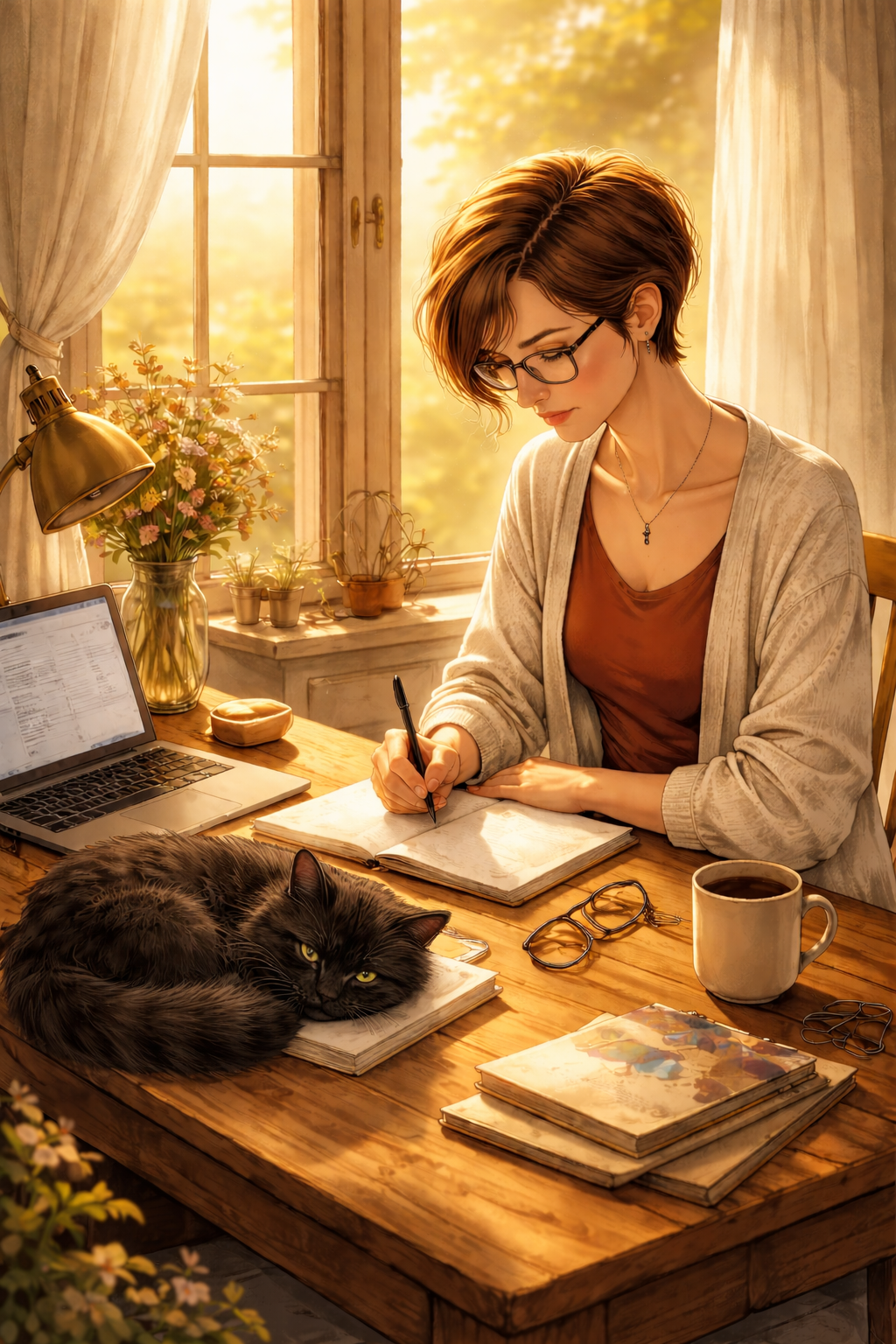
Her desk was by the window. He had chosen it himself — solid wood, simple, exactly right. The room faced east, just as he had said, and at seven in the morning the sun came in across the floor and reached the corner of the desk where she kept her notebooks and her second coffee, and the light was warm and unhurried and asked nothing of her.
Tuscan lay across the far corner of the desk while she typed. He had decided, in the first week, that this was his position — turned away from the screen as a matter of principle, his tail describing a slow arc that occasionally swept across a sentence she was working on. She typed around him. She had always typed around him. Bruno lay below, his chin on her foot, entirely unbothered by the cat above him. They had reached their arrangement. It held.
She wrote. The next manuscript, and then the one after that. She wrote with the city below and the sun moving slowly across the room and, in the evenings, him coming home and the sound of the door and Bruno getting up to go and meet him and Tuscan pretending not to notice, and the ordinary particular music of two people who have finally, after years and oceans and all that distance, put themselves in the same place.
No ceremony had been needed. No titles, no declarations. They were simply committed in the way that matters — in the daily, unglamorous, stubborn way of two people who choose each other every morning and know it.
She had been invisible once. She had watched him from across a schoolyard and thought nothing would ever connect them.
The sun came through the window. Tuscan shifted, reclaiming a small additional portion of the desk. She moved her notebook two inches to the left. She opened it. She began.