SAM Ruh
Umrah Chronicles — Chapter 8 · The Biriyani Spot
Menu
SAM Ruh Umrah Chronicles
Umrah Chronicles · Chapter Eight

The Biriyani Spot

Far from home, a small restaurant in the Gulf served something
no city, café, or substitute ever could — the taste of belonging.

Chapter Eight

Kutty — The Man Who Knew

He took them there not because it was famous. But because he understood exactly what they needed.

Kutty was what they called him at first. Later, he declared his name was Hussain. And later still, they would come to understand a little of his story. He had listened to them — really listened — during the entire drive. The three of them had been chirping about food the whole way. Not just food. Malabar food. The craving had been building ever since they landed in the Gulf. The chai hadn't hit the right spot. The halal burgers and sandwiches hadn't tempted them either. Something was missing — and they could feel it in their bones.

So Hussain took them there. Not because it had rave reviews or a famous name. But because a man who truly listens knows exactly where to go.

A Piece of Malabar

Biriyani Spot

Nothing poetic. Nothing loud. Just a name doing exactly what it sounded like — its duty.

The drive was not long. The board outside read — Biriyani Spot. Nothing poetic about it. Nothing loud or blaring. Just a name doing its duty. And yet the word alone — biriyani — has always felt royal. It carries a kind of weight that makes one feel rich and tended to, as though someone has taken real care on your behalf.

Inside, people spoke and laughed as though they had known each other for years. Familiarity seemed to be part of the menu. The air was warm and carried the deep aroma of a kitchen that knew what it was doing — the kind of smell that does not ask permission before it settles into you.

It felt like our own home. A place where they could be themselves. A familiar feeling — one that settles gently in the heart and reminds you what comfort feels like in an unfamiliar space.

Each table held its own small universe, separated by a cloth curtain that swayed gently whenever someone passed by or peeked in. Malayalam filled the room — unpolished, affectionate, and easy. Some dialects sounded familiar; others sounded different in the most interesting way. Then came Shoukath Ali — the waiter with glasses and a warm smile, who recited the menu like poetry. He was from Tirur, close to Nilambur. A neighbour from back home, found in the most unexpected corner of the world.

The orders were placed with ease and no restraint. Malabar food is never about a single dish. It is about abundance, about generosity, about leaving no room for regret.

The Dish

The Irrachi Putt

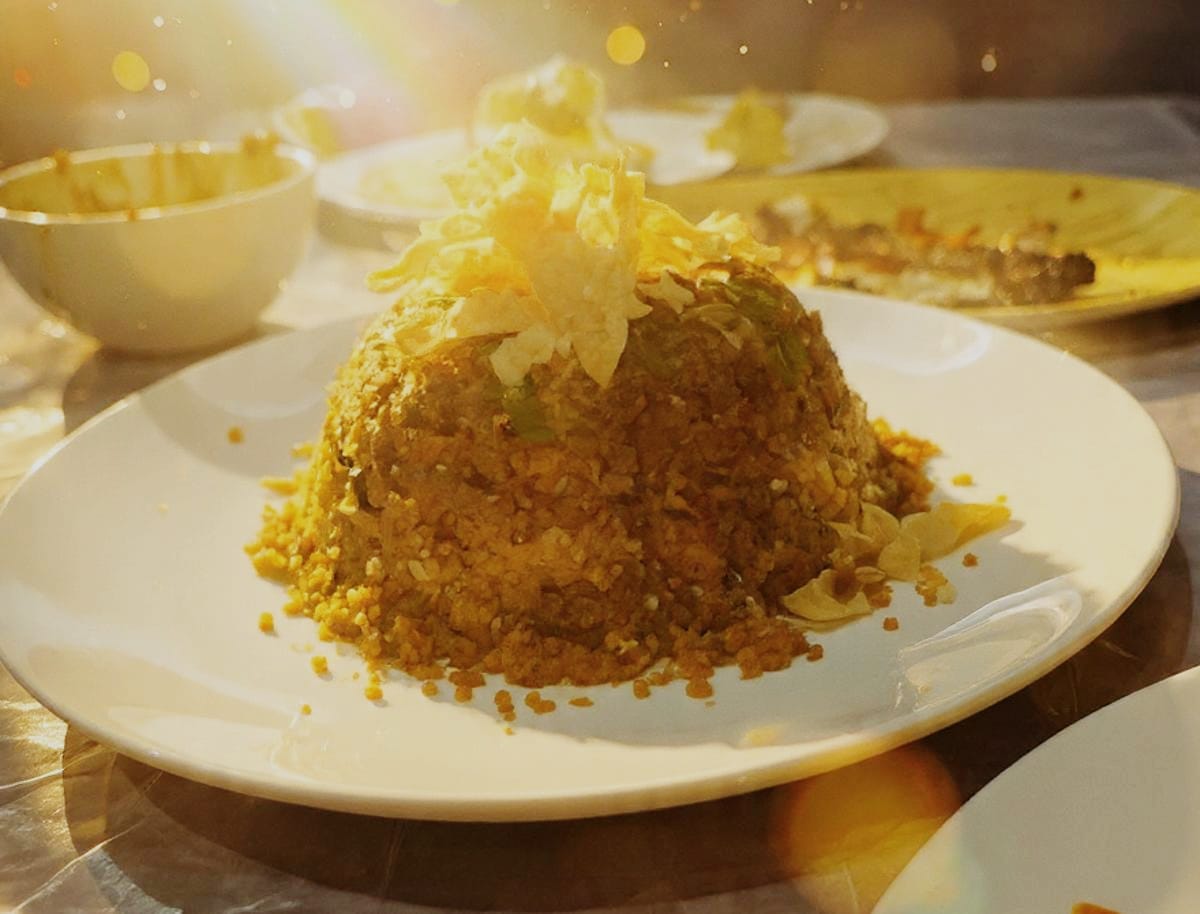
It arrived without announcement. Brownish green, almost earthy. It did not perform for you.

The dishes arrived in installments — first the salad, then beef and porotta, then a stream of others. And then came the irrachi putt. It arrived without ceremony. Brownish green, almost earthy. It looked harmless and innocent. Broken papadam rested on top — not arranged, just placed. Cracked. Casual. Honest. The kind of food that does not perform for you.

Beef masala blended into tiny pellets of rice flour — not separated, but working together as partners. Each grain felt as though it had been given time, slowly cooked, never hurried. The beef cubes were soft and yielding. The whole dish sat on the plate like a small, quiet mountain.

A small portion was scooped onto the plate. Then the first morsel. The first bite. It was warm. The texture gave in gently — soft, smooth, no resistance, no struggle. And then, quietly, it happened.

Contentment. A fullness that did not sit in the stomach alone, but settled in the chest. A feeling not recognized in a long, long time.

Chai was called for, because some flavours demand companionship. The spicy warmth of the irrachi putt only deepened alongside a proper desi chai. It arrived in a glass cup — effortless, the clear winner of the afternoon. It wrapped around the irrachi putt and held it, lifted it.

Soon enough, the plate was empty. But the wanting was not. Another plate was ordered. The chai cups emptied too, and then those were ordered again as well. Behind the curtain, life continued its quiet hum.
A Reflection

What Stayed

Some meals feed the body. This one fed the space where tiredness lived.

The second plate of irrachi putt ended. The chai cups emptied for the last time. But something remained — a quiet, unhurried gratitude that had no particular shape, only weight.

Some meals feed the body. This one fed the space where tiredness had quietly taken up residence. That afternoon, far from where they came from, a simple dish did what cities, cafés, and substitutions had not been able to do.

Home is not always a place. Sometimes it arrives quietly on a plate, warm and waiting, asking nothing more than for you to remember who you are.

© SAM Ruh — Words. Worlds. Wonder.