Understanding the Sacred
What Is the Rawdah?
The garden between his house and his pulpit — a piece of Paradise on Earth.
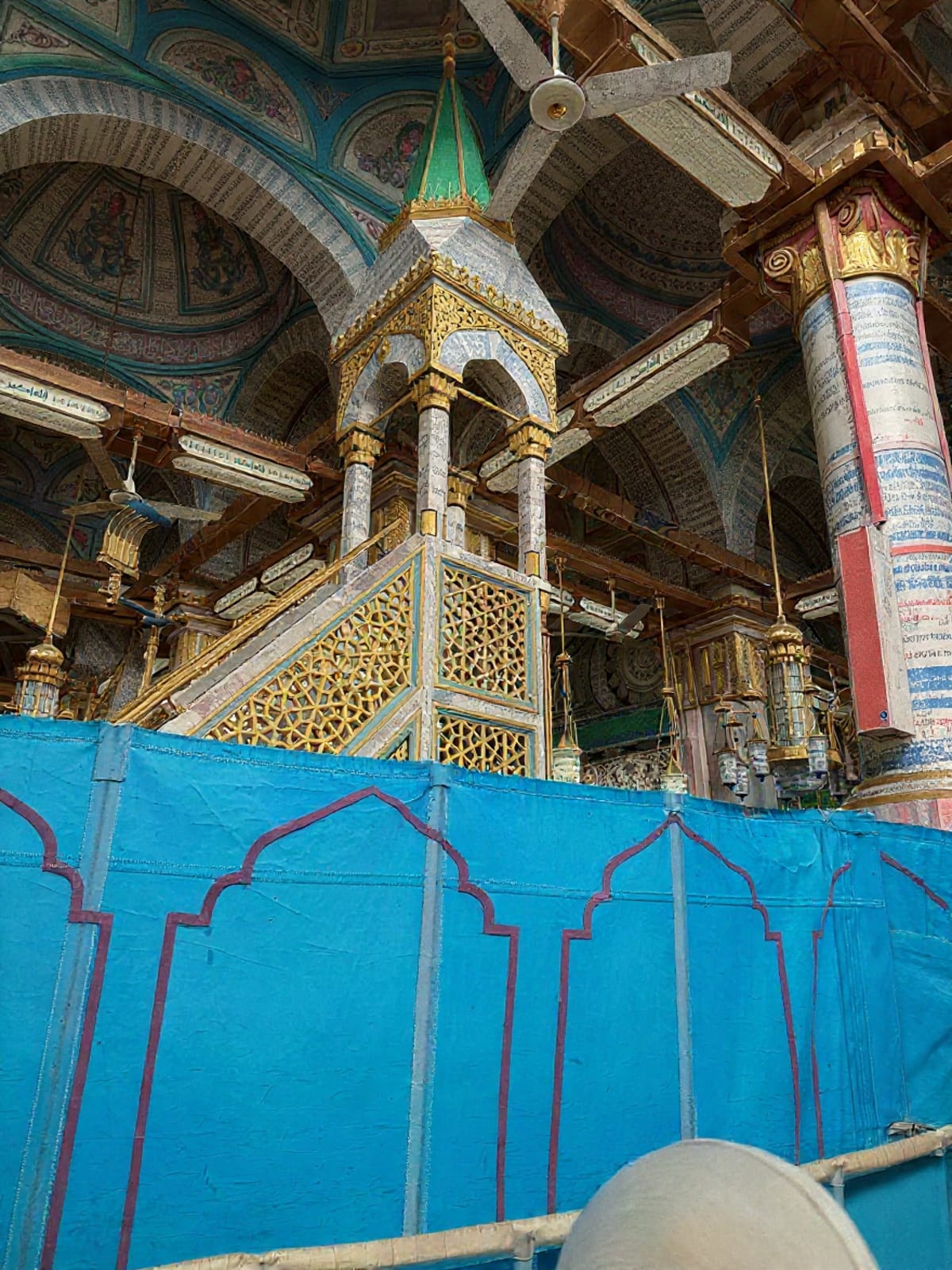
The Rawdah — more precisely, Rawdah Mutahharah — refers to the sacred area within Masjid an-Nabawi, the Prophet's Mosque in Madinah al-Munawwarah. It is the blessed space that stretches between the home of the Prophet Muhammad ﷺ, where he now rests, and his noble pulpit, the Mimbar, from which he delivered his sermons to the early Muslim community.
It is considered one of the most blessed and spiritually elevated places in all of creation — a garden that the Prophet ﷺ himself described as being of Paradise.
What is between my house and my pulpit is a garden from the gardens of Paradise.
— Prophet Muhammad ﷺ · Sahih Bukhari & Sahih Muslim
For believers who make the journey to Madinah, visiting the Rawdah is among the most profoundly anticipated moments of their lives. To stand in that space, to pray two rakats in a garden the Prophet ﷺ himself named as part of Paradise, and to draw near to his resting place — it is a closeness that cannot quite be described, only felt.
Chapter Nine
The Visit to the Rawdah
No time for rest. Only a quiet gathering of hearts, and the walk toward something sacred.
There was no time to rest or sleep — only a brief pause, just enough to gather their thoughts and steady their excitement. They quickly freshened up, washed their faces, and prepared themselves for the walk to the Rawdah. The moment they stepped out of the hotel, every step toward Masjid an-Nabawi felt lighter, as though the blessings of what awaited were already pulling them forward.
The walk to the Haram was quick and familiar. But the path to the Rawdah itself was longer — it was located on the other side of where they had entered before. Their hearts quickened as they approached the area where many women had already begun queuing, waiting patiently for their turn to enter this sacred space.
Finding the Right Gate
They joined the crowd. Nazia and Soni began comparing notes about the gates they had used on a previous visit — there was a mismatch in their recollections, so they decided to ask someone whether they were waiting at the right place. It was only then that they realised they needed to enter through Gate 37, the designated entry point for their appointment slot. They moved swiftly, found the correct gate, and joined the queue.
Around them, the atmosphere was charged with quiet emotion. Some women were in tears; others looked anxious. A lady standing just behind them moved nervously and accidentally gave them a small nudge. When Shehnaz gently turned to check on her, the woman explained her worry — her appointment was at 12 p.m., and she feared she might be turned away if the time had lapsed. Shehnaz reassured her warmly: many of them shared the same appointment window, and it would be fine even if a little time had passed. Still unsettled, the woman remained visibly tense. Without a second thought, they invited her to move ahead of them in the line.
Soon, the crowd was arranged into three orderly lines and guided toward the entrance of the Rawdah.
❧
Entering the Garden
It was their turn. Each of them scanned their appointment QR code — a modern ritual seamlessly woven into centuries of tradition. They were guided inside calmly, with no rush or chaos, only gentle, unhurried movement that seemed designed to let every sight and sensation settle deeply into the heart.
Each step forward carried the weight of history. They could feel the generations who had walked this same ground — who had touched these floors with devotion, who had revered this space with every fibre of their being. The Prophet ﷺ had once walked here, taught here, prayed here. And now, here they were.
They were led to a designated spot to perform two rakats of Sunnah, and the strength of the moment was almost overwhelming. Many women nearby were visibly moved — some holding back tears, others with eyes closed, overcome by the nearness of him ﷺ.
One of the women standing beside Shehnaz wept quietly, tears slipping down her face as love for the Prophet ﷺ poured out of her. And in truth, they all felt it. Every single one of them. They lined up and prayed with everything they had.
Shehnaz made a deliberate effort to open her heart fully — to deepen her love for the Rasul ﷺ and set aside the questions and doubts that had occasionally lingered in her mind. This was not a space for uncertainty. It was a space for sincerity and surrender. Nazia and Soni, too, were immersed in awe, their hands rising naturally in dua, seeking blessings, guidance, and the grace to grow. They all prayed again quietly within the sacred space, savouring the moment as though time itself had slowed to make room for their devotion.
Drawing Near
They walked calmly and in perfect order, one following the other, barefoot on the cool marble floor. There was no pushing, no jostling — only the quiet grace of people who understood where they were. Every step brought them closer to the Mimbar, the very pulpit from which the Prophet ﷺ had once addressed his companions, his words shaping a faith that would reach across centuries and continents to reach them, too.
They arrived at the spot where they were truly close — close to the Mimbar, close to the area where the Prophet ﷺ rests. Although the women could not see the noble grave directly, there was an unmistakable sense of nearness. Something ineffable and yet entirely real. Each of them paused, allowing the moment to settle into the deepest part of themselves.
There are no words sufficient for what it feels like to stand there. The heart simply knows it is somewhere it has always belonged.
Eventually, as is the way of this sacred place, they were gently guided to move along, making space for the next wave of visitors. They exited with hearts full yet serene, stepping back into the living, breathing atmosphere of the mosque surroundings. Outside, they found Saji waiting for them patiently, as he always did. Together, they decided to take a slow walk through the surrounding streets — to explore, to breathe the Madinah air, and to look for small treasures to bring home.
After the Rawdah
An Evening in Madinah
The city that never quite sleeps — and the quiet joy of wandering its streets with a full heart.
The streets surrounding Masjid an-Nabawi were vibrant yet calm, humming with the quiet rhythm of a city that seems to honour its own sacredness. As they walked, they found themselves marvelling at it — this was the city with a real nightlife, they joked. Not the restless, neon kind, but the kind born of devotion: streets alive at all hours because the House of Allah never truly closes, and those who love him ﷺ have no wish to be far.
They wandered freely, peering into shops. Some shopkeepers stood at their doorways, warmly coaxing passers-by to come in and look. The lanes were lined with abayas, silver jewellery, bottles of precious oud and medicinal oils, dates piled high, and thobes in every shade. It was the kind of gentle, purposeful commerce that felt entirely in keeping with the spirit of the city.
A Small Sadness
As she walked, something caught Shehnaz's eye — or rather, something she expected to see was missing. On her previous visit, cats had wandered these same streets freely, unhurried and utterly at ease, accepted as quiet inhabitants of the sacred city. This time, there were none. Their absence tugged at her heart in a way she hadn't anticipated. It was a small thing, perhaps. But it was a reminder that even the most beloved of places shifts with time, and that memory holds things the present sometimes lets go.
❧
Small Treasures, Quiet Gratitude
After a pleasant spell of browsing, they collected a few things to bring home: abayas for the little girls, chocolates, and a selection of medicinal oils. Nothing extravagant — just small pieces of Madinah to carry back to those they loved.
With the night deepening and Tahajjud prayers on their minds, they turned back toward the hotel. The walk was short — one of the many quiet blessings of their upgraded room, which had placed them so close to the Haram that every visit felt effortless, as though the distance between them and the mosque had been removed by divine generosity.
The only delay was the elevators. Despite there being several, the wait for one to arrive and carry them to their floor stretched longer than it should have. They laughed about it in the way that only pilgrims can — because when everything else has been a gift, even the small inconveniences become endearing.
They settled into their rooms, hearts heavy with gratitude. The serenity of the Rawdah, the closeness to the Prophet ﷺ, the gentle streets of Madinah, the blessing of good companionship — everything had aligned. Everything had been easy. And ease, in the sacred cities, feels like a love letter from Allah.
There was no need for words that night. Their minds and hearts repeated their gratitude to Allah — for the ease, for the guidance, for the profound and undeserved peace they had been allowed to carry within the bounds of this sacred city.
Tonight, they would rest. But their spirits remained awake, carrying the memories of the Rawdah and the blessings of Madinah gently within them. Later would bring more prayers, more moments of awe. But tonight belonged entirely to this — a night wrapped in devotion, gratitude, and the quiet, luminous joy of having stood near the resting place of His beloved Prophet ﷺ.
"Indeed, Allah and His angels send blessings upon the Prophet. O you who believe, send blessings upon him and salute him with worthy salutation."
— Qur'an 33:56