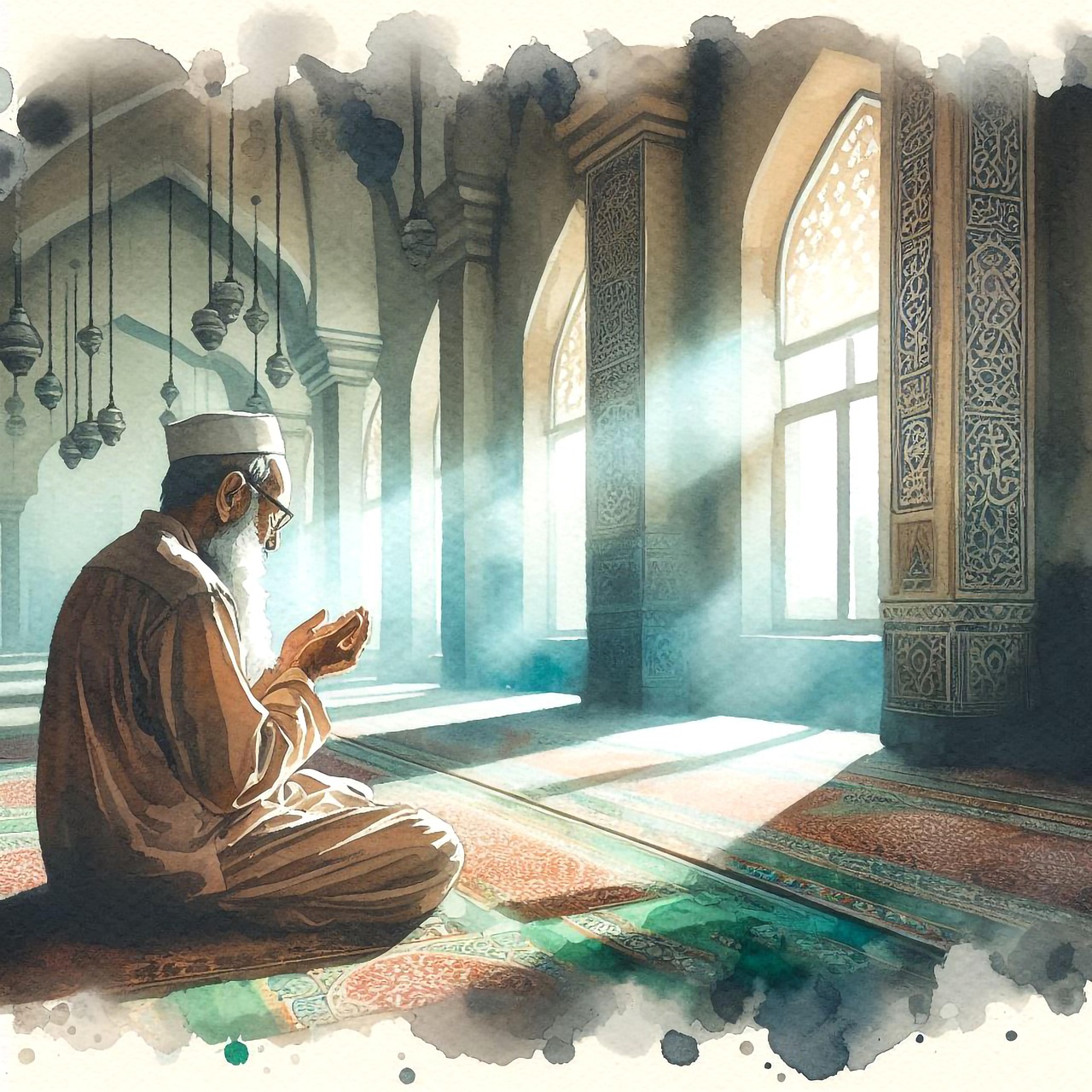
When You're on the Outside Looking In
A reflection on expectations, disappointment, and finding khair in what we did not plan for.
The Umrah Glow and High Expectations
I came back from Umrah not long ago, and the feeling has not quite left me. You know that sensation — the lightness in the chest, the clarity of mind, the way everything begins to feel a little more purposeful and a little more aligned. The calls to prayer sound sweeter. The Qur'an feels more immediate. The heart softens and opens in a way that ordinary days rarely allow.
So naturally, I was looking forward to Ramadan with a particular kind of anticipation. I imagined it as the natural continuation of what I had carried back from Umrah. The spiritual momentum would flow straight into the blessed month, and I would not have to force anything. The motivation would already be there — the extra prayers, the late-night recitation, the mindfulness in every action. It would all unfold as it should. I was ready. Or at least, I believed I was.
The News I Did Not Want to Hear
A few days before Ramadan, I was speaking with a dear friend. She mentioned, almost apologetically, that her period had arrived. She would not be able to fast the first few days. And like so many of us, she was quietly anxious — worried she might miss the last ten nights, the most sacred portion of the month, the nights when Laylatul Qadr rests hidden like a gift waiting to be found.
I tried to offer comfort, but inwardly I felt a quiet relief. At least that will not be me, I thought. I am approaching menopause, or so I believe — my cycles have been irregular, unpredictable, sometimes absent for months altogether. I was confident, perhaps too confidently, that this Ramadan would be uninterrupted. That I would fast all thirty days without pause.
And then, of course, I was proven wrong. My period arrived. And without meaning to, I found myself sending my friend the exact message she had sent me only days before: "I am in the same position. I cannot fast either." We both sat with the same quiet anxiety: What if we miss the last ten days? What if the most powerful nights of the year pass while we are waiting on the sidelines? Coming to terms with that was harder than I had expected.
Watching from the Sidelines
When the announcement arrived — Ramadan begins tonight after Maghrib — the entire household shifted into a different atmosphere. You could feel it. My eldest son immediately took on the role of guide for his younger siblings, walking them calmly through what the next thirty days would hold. "This is what changes," he said. "This is what is forbidden. This is what is permitted. This is how we will structure our days."
I watched it all from a quiet distance, aware of a heaviness in my chest that I had not anticipated. They were preparing. They were present. And I was, in a very real sense, on the outside of it. I would not be praying with them. I would not be fasting alongside them. I would be present in every practical way — making suhoor, preparing iftar, holding the household together — but I would not be doing what they were doing. There is a particular kind of ache in that. Like being in the room where something beautiful is happening and being the only one who cannot fully enter it.
Taraweeh at Home — and the Guilt That Came With It
That evening, we prayed Taraweeh at home. The children had school the following morning, and I made the decision: we would stay home, pray together here, and get adequate rest. It is recommended that men attend the masjid for Taraweeh, and watching them pray in the living room instead of going out, I felt the weight of that choice.
Had I made the right call? Was I keeping them from something greater? Was I placing convenience above blessing? I reasoned it through — they needed rest, the day ahead would ask much of them — but the doubt did not fully leave. This is the kind of internal negotiation mothers undertake constantly during Ramadan — balancing everyone's needs, attempting to make the right choices, and never being entirely certain they have succeeded.
Suhoor — Participating in the Only Way I Could
We all woke together for suhoor. The house was quiet — only the sound of water running, dishes clinking, voices still soft with sleep. I decided to fast anyway. Not out of obligation, but because the thought of eating during Ramadan while I was exempt felt wrong in a way I could not fully articulate. I drank a full cup of coffee, which I would later regret, but in that moment it was my way of belonging. Of being part of what was happening, even if I could not pray.
I made sure the children ate enough and drank sufficient water. I reminded them about Tahajjud, about the sunnah prayers before Fajr. I watched them stand in prayer while I sat quietly at the side, making du'a in my heart instead of with my body. And then I texted my friend.
There Is Khair in This
She wrote back. We went back and forth for a while — both of us trying to process how strange it felt to be excluded from what we had prepared for. To be physically present for Ramadan but spiritually on the periphery, watching everyone else engage in ways we could not.
Khair — goodness, benefit, blessing. The thing we do not always see in the moment, but that Allah, in His infinite wisdom, has woven into every circumstance, including the ones we did not choose and would not have chosen.
I held that for a while. There is khair in this. Not merely patience offered as a consolation prize. But actual, intentional goodness that Allah has placed within this very situation — in the waiting, the watching, the feeling of being left out.
Perhaps the khair is in learning to separate worship from ego — in recognising that my worth as a believer does not rise and fall with how many fasts I complete or how many rak'ahs I pray. That Allah sees the intention, the longing, the frustration — and counts all of it. Perhaps it is in empathy: understanding, deeply and personally, what it feels like to be on the outside. Perhaps it is in surrender: accepting that I am not in control of my body, my circumstances, or the shape this Ramadan takes — and that Allah is. He is Ar-Rahman, Ar-Rahim, Al-Hakim. His plan is not an accident.
Watching Them Leave
I watched my children get ready for school. Fresh clothes, backpacks on their shoulders, heading into their first full day of fasting with a visible mix of excitement and nerves on their faces. I made du'a for them as they walked out the door. Ya Allah, make this easy. Do not let it feel like a burden. Let them find joy in it. Let them experience the beauty of Ramadan, not just its difficulty.
And then I made du'a for myself, for my friend, for every woman sitting at home today who wished she could fast but could not. For everyone who feels left out or overlooked, or as though they are missing the full experience of this blessed month.
Ya Allah, let us find the khair. Let us trust that You see us, even when we are not standing in prayer. Let us know that our longing to worship You is itself a form of worship. And when we are able to fast and pray again, let us return with gratitude — not merely relief.
A Word for Anyone Else Who Is Waiting
If you are reading this and find yourself in the same position — whether because of your cycle, an illness, pregnancy, postpartum recovery, or any other reason — I want you to know something clearly: you are not less. You are not missing out. You are not on the sidelines in the eyes of Allah. He knows what you wish you could do. He sees the intention your heart holds.
"When a servant falls ill or travels, he will receive the reward equivalent to what he used to earn through his good deeds when he was healthy and at home."
BukhariYour inability to fast does not erase your worship. It does not diminish your Ramadan. Allah is recording everything — the longing, the patience, the quiet acts of service, the du'as offered while everyone else prays. This Ramadan is still entirely yours. It simply looks different from what you imagined.
Moving Forward with Intention
As this first day moves slowly forward, I am choosing to hold onto what my friend reminded me: there is khair in this. I do not fully understand it yet. I am still sitting with the disappointment, the guilt, the feeling of being on the outside of something I wanted to be inside of. But I am choosing to trust that Allah's plan is better than mine — and that the Ramadan He has written for me, periods and all, is precisely the Ramadan I need.
May Allah make this month gentle for all of us. For those who are fasting, for those who are waiting to fast, for those caring for others while they fast. May He accept our intentions, forgive our shortcomings, and grant us the blessing of experiencing the beauty of this month in whatever form He has chosen for each of us.
Ameen.
"And whoever relies upon Allah — then He is sufficient for him. Indeed, Allah will accomplish His purpose. Allah has already set for everything a decreed extent."
Qur'an 65:3A Personal Du'ā
Calling upon Al-Raḥmān, Al-Raḥeem, and Al-Raouf — by every name, in every need.
Yā Raḥmān — the One whose mercy stretches across every heaven and every earth, reaching every soul that breathes without exception — surround me with that vast and boundless mercy. Let Your mercy arrive before my mistakes do. Let it precede my failures, my shortcomings, every moment I fall short of who I am trying to be. Let it cover the weaknesses I show the world and the silent struggles I have never quite found the words to name.
Yā Raḥeem — the One whose mercy is sustained and intimate, reserved especially for the believers, active and ongoing — grant me a mercy that softens what life has hardened in me. Strengthen my īmān from its roots. Keep me firm upon Your dīn in the easy days and the unbearable ones alike. Let me feel Your closeness in my sujūd, in my tears, in the quiet moments when no one sees me but You — and let that closeness be enough.
Yā Raouf — the One whose compassion is tender and active, who does not merely witness hardship but moves to relieve it — be gentle with me in every decree You write for my life. If You withhold something, let it be a protection I cannot yet see. If You grant something, let goodness be woven all the way through it. If You test me, let it be the kind of test that purifies without destroying. Deal with me the way only You — the Most Gentle — truly knows how.
Yā Allah, give me everything I need in this dunya — physically, emotionally, spiritually, financially, and socially. You know my needs before I name them, and You know which of my desires are genuinely good for me. Grant me what I long for when it carries khayr, and gently remove from my heart any longing that would damage my ākhirah — even when I cannot see the harm myself.
Yā Raḥmān, grant me rizq that is ḥalāl, abundant, and filled with barakah from beginning to end. Protect me from the humiliation of debt. Protect me from dependence on people when only You can truly provide. Grant me strong health — not merely the absence of illness, but genuine strength and vitality. Grant me clarity of mind, balance in my emotions, and a heart filled with light born of closeness to You.
Yā Raouf, protect me from illnesses that weaken not only my body but my connection to You. And if illness does come — let it serve as expiation, as elevation, and as an invitation to turn toward You more completely than I do in health.
Yā Raḥeem, forgive me — completely, entirely, without remainder. Forgive the sins I carry with shame and the ones I have long since forgotten. Forgive the sins committed in public and those buried in private, when I thought no one was watching — forgetting that You always are. Forgive the sins of my eyes, my tongue, my hands, and my thoughts. Forgive the prayers I delayed, the dhikr I left unspoken, the Qur'an I left closed when I could have opened it.
Purify my heart, Yā Allah — from every layer of hypocrisy I may not yet recognise in myself. From envy that masquerades as concern. From pride dressed as confidence. Remove from me every trace of resentment and doubt that builds distance between me and You. Replace what You remove with something better — hypocrisy with sincerity so complete that my private self and my public self become one. Replace doubt with a certainty in You so deeply rooted that nothing can shake it.
Yā Raouf, grant me emotional strength — not the brittle kind that pretends nothing hurts, but the grounded, rooted kind that can feel pain and still remain anchored. Heal the wounds I carry that only You know the full depth of. The ones I have learned to work around. The ones I stopped speaking about because I ran out of words. The ones that surface uninvited in quiet moments and remind me they are still there.
Replace every heartbreak with something better than what I lost. Replace every disappointment with the wisdom to understand, in time, why things had to unfold the way they did. For every du'ā I have made that remains unanswered — replace the waiting with trust. Do not allow the unanswered du'ā to become a reason for despair. Let it become a reason for certainty that You are planning something better than what I imagined.
Replace my anxieties with a tawakkul so genuine it settles in my chest like a weight lifted. Replace my sadness with the sakīnah that only You can place within a heart. Make me genuinely and lastingly hopeful, Yā Raḥmān — hopeful in Your mercy, rooted in Your promise.
Yā Raḥmān — bless my parents with forgiveness that wipes their record completely clean. Grant them health that comes with ease. Honour them in this world and the next. Give them long lives spent in obedience to You — and make those lives full and dignified, not diminished. Reward them for every sleepless night spent worrying about me, every sacrifice made quietly and without expectation of acknowledgement, every silent burden carried so I would not have to carry it. Give them what they deserve from You, which is far more than what I could ever give them from myself. Grant them the highest ranks in Jannah.
Bless my siblings with righteousness, success, and deep contentment. Keep our hearts tied to one another — remove jealousy, misunderstanding, and the quiet distance that creeps in when life pulls us in different directions. Let our bond be one that makes each of us better, stronger, and closer to You.
Protect my children, Yā Allah — every one of them, in every dimension of their being. Guard their īmān from the doubts this world plants so casually. Protect their hearts from corruption before it takes root. Protect their minds from confusion and their bodies from every form of harm, seen and unseen.
Make them true lovers of the Qur'an — not merely people who recite it, but people who are shaped by it, guided by it, and comforted by it in their darkest hours. Make them sincere followers of the Sunnah of the Prophet Muhammad ﷺ — in his gentleness, his dignity, his patience, and his complete and unwavering trust in You. Make them confident enough to stand by their dīn, compassionate enough to draw people toward it, strong enough to carry it forward to their own children one day.
And Yā Raḥeem — let them be a source of ṣadaqah jāriyah for me long after I am gone. Let their good deeds, their prayers, their knowledge, and their kindness flow back to me as a continuous and unending gift. Let them remember me in their du'ā.
Yā Raouf, protect my home. Guard it from envy, from the evil eye, from every form of harm that enters through visible and invisible channels alike. Fill my home with sakīnah — real, felt, inhabitable peace that greets you the moment you cross the threshold. Let dhikr be the sound my home knows best. Let laughter and warmth be its constant residents. Let the angels who accompany the remembrance of Allah find within my home a place they wish to dwell.
And Yā Raḥmān — protect even my cats, and every creature under my care. You are the One who rewards kindness extended to animals. Let my home be a mercy for everything that lives within it.
Yā Raḥmān, grant me excellence in my career and genuine purpose in my work. Let my skills benefit the people I serve — not just efficiently, but meaningfully. Place acceptance and barakah in everything I create and contribute. Open doors for me that no one can close — doors of opportunity, of growth, of recognition that arrives at the right time. And quietly, firmly, close the doors that would lead me somewhere harmful — even when I am standing before them convinced they are what I want.
Grant me good company, Yā Allah — people who remind me of You by their very presence. Friends who make du'ā for me in my absence, who speak truth to me gently, who celebrate my growth without envy. People who make the path to You feel less solitary. And from my life, remove the influences that pull me away from You — quietly, completely, without upheaval.
Yā Raḥeem, grant me discipline in worship — not the reluctant, mechanical kind, but the kind that flows from a heart that genuinely wants to show up. Make my ṣalāh consistent: five times, every time, full of khushūʿ. Let me not merely stand in prayer but arrive in it — present, conscious, and aware of Whose presence I am standing in. Make the Qur'an the light of my chest. Keep my tongue engaged with dhikr throughout every ordinary hour. Grant me the gift of tahajjud — the ability and will to rise in the last third of the night, when the world is still and the distance between us feels smallest.
Place in my heart a deep, sincere, and ever-growing love for Prophet Muhammad ﷺ — the kind of love that is not merely felt but lived. Allow me to follow his character with sincerity — his patience, his mercy, his dignity, his unwavering trust in You. Gather me under his banner on Yawm al-Qiyāmah. Let me drink from his blessed hands at Al-Kawthar.
Yā Raouf, be gentle with me as I age. Be gentle with me as my body changes and slows. Grant me a beautiful ending — a husn al-khātimah that is the seal of a life spent turning toward You. Let my last words be the shahādah — spoken with ease, with certainty, with a heart entirely at peace. Take my soul while You are pleased with me.
Yā Allah, prepare me for my grave long before I reach it. Make it wide and filled with light — a garden from the gardens of Jannah. Protect me from its darkness and its punishment. Make me firm when questioned. And Yā Raḥmān — on the Day of Judgement, do not disgrace me. Place my book in my right hand. Make my scales heavy with good deeds. Make my reckoning easy. Do not let me taste the punishment of Hell — not even for a moment.
Grant me Jannatul Firdaus — the highest, the closest to Your Throne — not by the measure of my deeds, but by Your mercy, which has no ceiling. And unite me there with my parents, my siblings, my children, and everyone I have loved in this life — in a place where loss no longer exists, where we dwell together forever in Your presence.
Yā Raḥmān — love me. Not because I have earned it. But because You are the very source of love, and I am entirely and completely in need of it. Yā Raḥeem — draw me near to You. Close enough that worship stops feeling like effort and starts feeling like coming home. Yā Raouf — be gentle with me until the very end.
Do not leave me to myself — not for the blink of an eye. Accept this du'ā. Forgive me, guide me, protect me, and grant me eternal success in the only way that truly lasts. And Yā Allah — if I do not make it to tomorrow, let today have been enough.
Āmīn yā Rabb al-ʿĀlamīn
I Forgive You
A Ramadan declaration of release — for everyone who has ever hurt me, and for myself.
The Decision to Let Go
There is a particular kind of weight that accompanies unresolved hurt. You may not always feel it consciously — it becomes so familiar over time that it begins to feel like part of you, like background noise you have stopped noticing. But it is there. In the way your body tenses when a certain name comes up. In the way a memory surfaces without invitation and quietly takes something from your day. In the guardedness you carry into rooms full of people who have never hurt you, because some who did taught you that trust is a risk.
Ramadan has a way of asking you to put things down. The hunger strips away the noise. The nights invite honesty. And somewhere within that honesty, I arrived at a decision I have been circling for longer than I would like to admit.
I forgive everyone.
All of Them
The ones who hurt me deliberately — who chose their words knowing they would land badly, who acted with the specific intent to diminish, dismiss, or wound. I forgive them. The ones who hurt me without meaning to — who were careless, distracted, or simply did not know better given what they had at the time. I forgive them too. Unintentional hurt is still real hurt, and it still deserves to be released.
I forgive my parents — for what they did that marked me, for the patterns they passed on without realising it, for the moments they were too human when I needed them to be more. They gave what they had. I forgive the distance between that and what I needed. I forgive my siblings, my spouse, my children, my friends — those still present and those who drifted away. The ones who showed up when it was convenient and went quiet when it truly mattered. The ones who knew what I was carrying and said nothing.
Even the Small Things
I forgive the people who did not smile back. This may sound minor. It is not. There is something quietly painful about reaching toward someone — even just with a smile, the smallest offering of warmth — and having it met with nothing. It makes you feel invisible. I have carried those moments far longer than they deserved.
I forgive the ones who made me feel small — who talked over me or past me, who made my presence feel like an inconvenience, my opinion like something not worth hearing. I forgive the ones who diminished me subtly, with the kind of remarks that could always be explained away as jokes, as misunderstandings, as oversensitivity on my part. I forgive even my own confusion about whether what happened was real. I forgive the ones who looked away when I needed to be seen.
What Forgiveness Is Not
Forgiving them does not mean what they did was acceptable. It does not mean I am welcoming them back into my life, erasing what happened, or pretending the hurt was not real. It does not mean they were right.
Forgiveness means I am choosing not to carry them anymore. I am setting down the weight of the story in which I am permanently wounded and they are permanently the ones who caused it. That story has been heavy. I am tired of carrying it. This is for me as much as it is for them. Perhaps more.
And Then — Myself
Because if I am being completely honest — the kind of honesty that Ramadan asks for — I also need to forgive myself. For the times I was the one who caused the hurt and knew it. For the times I held onto grievances longer than was good for anyone, including me. For the years I spent asking why instead of asking what now.
I forgive myself for not being further along. For still struggling with things I believed I would have resolved by this point. For the gap between who I am and who I am in the process of becoming.
Yā Allah — You are Al-ʿAfuw, the One who pardons completely, erasing what was there as if it never existed. I am asking You today to help me carry that same spirit within my own heart. I release everyone who has hurt me into Your hands. Judge between us with Your justice, and cover us both with Your mercy. Do not let their wrongs become my chains. And forgive me, too, for every time I was the one who caused the wound.
The Lightness That Comes After
I am not certain whether forgiveness is a single decisive moment or a practice you return to repeatedly. Probably both. Probably you say it once with your whole chest, and then you say it again on the days the old feelings resurface, and you keep saying it until the saying gradually becomes the truth of how you actually feel.
But I am beginning today. In this Ramadan. In this season of honesty and hunger and turning toward Allah. I forgive them all. And I am asking Allah to fill the space that releases with something better — with a peace that does not depend on anyone else's apology, with a heart soft enough to love without keeping score, with the freedom that belongs to those who are no longer tethered to what was done to them.
This is what I want my heart to look like when Ramadan ends. Not heavier. Lighter. Cleaner. More open.
Ameen.
How the Day Unfolded
A quiet day of barakah, balance, and finding your footing in the blessed month.
Alhamdulillah — It Went Smoothly
Day 1 of Ramadan passed with a gentleness I had not quite expected. Alhamdulillah. There is something deeply grounding about being able to work from home — to remain in your own space, your own rhythm, surrounded by the quiet of a familiar house. That proximity to your family, your Qur'an, and your own pace is a blessing easy to overlook until you sit with it deliberately.
Work Was Waiting
The weekend before Ramadan had brought a significant release at work, and its effects were still very much present. Emails, messages, calls — the inbox does not pause for the sacred. Day 1 did not begin with me being particularly sharp or effective. My mind was still adjusting, still finding the rhythm of the month. But we began early regardless. Suhoor done, children off to school, laptop open. There is something quietly courageous about that — the ordinary discipline of showing up, even when the sacred and the mundane are running alongside each other.
The Qur'an as Company
Since I was unable to pray salah, I made a deliberate choice: I would stay close to the Qur'an in whatever way I could. I turned to Al-Baqarah — not with ambitious goals or a rigid plan, but with genuine curiosity and a willingness to simply sit with it. I did not cover a great deal. But what I did cover left me feeling something I had not anticipated — hope. Contentment. A quiet and settled sense of this is enough for today.
Keeping Ramadan diaries is making me do things I would not usually do. The researching and learning that comes with it is a gift I did not plan for.
There is something about the act of documenting — about committing to reflection — that quietly pushes you toward doing more and being more intentional. The diary is not merely recording this Ramadan. In some small way, it is shaping it. So the day moved in that fashion — work handled, Qur'an open beside me, ayahs read slowly and turned over in the mind. Work and worship sitting side by side, not competing, simply coexisting.
When the Children Came Home
Work wound down, and I moved upstairs. The children were back, some resting, the familiar sounds of after-school life filling the rooms. One of them came to find me, needing to talk. We had a good conversation, the kind that reminds you why being present at home carries its own form of barakah. These small moments — the errand, the conversation, the quiet check-in — do not make it into the highlight reel of any Ramadan. But they are its texture. They are where character is actually built, in the unremarkable middle of ordinary days.
Maghrib and the Table
As Maghrib drew near, we gathered with the Qur'an translation and moved through Surah Al-Baqarah together — reading the meaning aloud, allowing it to land with some weight. And then the adhaan came, that sound that cuts through everything and calls you back to what matters, and it was time. We broke our fast together. All of us. Those who were fasting reached for their dates and water, and that familiar, relieved stillness settled over the table the way it always does at iftar. Maghrib was prayed, dinner was shared, and the evening continued in the gentle way that first days tend to.
Taraweeh and What Comes After
When Taraweeh time arrived, my sincere hope was to see everyone pray before they went to bed. To watch the night close the way a Ramadan night should — with their foreheads on the ground and their hearts directed toward Allah.
For my part, I found myself in an online healing session — one of those unexpected gifts the evening offered. Something for the soul after a full day of managing the practical. After which, insha Allah, sleep — and the intention already forming quietly for tomorrow. A better day. A more present one. That is the hope you carry into the night during Ramadan — not pressure, just the quiet and faithful optimism of someone who believes the next day holds something worth waking for.
Ya Allah, make each day better than the one before it. Let us find You in the ordinary moments — in the work, in the conversations, in the Qur'an open beside the laptop. Let our Ramadan be real, not merely beautiful on paper.
Ameen.
The Most Powerful Words for Forgiveness
A deep reflection on one of the most extraordinary phrases a believer can carry on their tongue.
There are phrases you recite because you were taught them. And then there are phrases you discover — not for the first time technically, but deeply, the way you suddenly notice something you have been walking past for years without truly seeing. This is one of those phrases for me. The full version, with al-ʿAẓīm, with al-Ḥayyu l-Qayyūm, with the deliberate declaration of tawbah at the end — this is a different matter entirely. This is istighfār with intention. With weight.
Breaking It Down — Word by Word
What Each Word Holds
Astaghfiru — The Covering
The word astaghfiru comes from the root gh-f-r — which carries within it the meaning of covering, concealing, and protecting. The word for a helmet in Arabic, mighfar, shares this same root. When you say astaghfiru, you are not simply asking for pardon. You are asking Allah to cover your sin — to shield you from its consequences, to conceal it from being exposed, and to protect you from what it might have invited into your life. It is protection. It is care placed like a covering over what is broken.
Al-ʿAẓīm — The Magnificent
When you invoke this name while seeking forgiveness, something profound happens: you are acknowledging that the One you are turning to is infinitely greater than your sin. No matter what you have done, no matter how heavy the weight of it feels, His greatness surpasses it entirely. You are not approaching a limited authority and hoping for a small pardon. You are turning to the Most Magnificent — whose capacity for forgiveness matches His greatness, which is to say it is without boundary.
Lā ilāha illā Huwa — The Declaration of Oneness
This is the core of the shahādah placed deliberately in the centre of a request for forgiveness. By saying lā ilāha illā Huwa, you are affirming that there is no one else to turn to. No other authority from whom pardon can be sought. No power capable of granting what you need except Him alone. You are not bargaining. You are not negotiating from a position of leverage. You are submitting — fully and consciously — to the only One who merits that submission.
Al-Ḥayy and Al-Qayyūm — The Greatest Names
The scholars are in near-unanimous agreement that Al-Ḥayyu l-Qayyūm together constitute what is known as Ism Allāh al-Aʿẓam — the Greatest Name of Allah. Ibn al-Qayyim explained that Al-Ḥayy encompasses all of Allah's attributes of essence — His knowledge, His power, His will — while Al-Qayyūm encompasses all of His attributes of action — His creating, sustaining, providing, and forgiving. Together they encompass the fullness of who He is. He was sustaining you through all of it, and He is sustaining you now as you return.
Wa atūbu ilayh — The Turn
The duʿā does not end with the request. It closes with a declaration of tawbah — repentance — and that distinction matters enormously. This final phrase transforms the duʿā from a passive petition into an active commitment. You are not simply saying forgive me. You are saying I am turning back to You. I am choosing a different direction. Sincere tawbah requires genuine remorse, cessation of the sin, and a firm resolve not to return to it. This final phrase is the seal of all three.
What the Ahadith Tell Us
Ibn Masʿūd (raḍiyallāhu ʿanhu) reported that the Messenger of Allah ﷺ said: "Whoever says this du'ā once — his sins will be forgiven, even if he had fled from the battlefield."
Sunan Abī Dāwūd, Hadith 1512 | Sunan al-Tirmidhī, Hadith 3577 | Declared reliable by ʿAllāmah Mundhirī
Ibn Masʿūd (raḍiyallāhu ʿanhu) also reported that the Prophet ﷺ said: "Whoever says this du'ā three times — his sins will be forgiven, even if he had fled from battle."
Mustadrak al-Ḥākim, vol. 1, pg. 511 | Declared authentic by Imām al-Ḥākim
Abū Saʿīd al-Khudrī (raḍiyallāhu ʿanhu) reported that the Prophet ﷺ said: "Whoever says this du'ā five times — his sins will be forgiven even if they are like the foam of the ocean."
Declared sound — ḥasan — by Shaykh Muḥammad ʿAwwāmah
Three narrations. Three different companions. Three different numbers — once, three times, five times — each reaching sins at a scale that strains the imagination. The foam of the ocean: the countless, surface-covering, uncountable measure of everything you have ever done wrong — and five repetitions of this phrase reaching every last one of them.
What Istighfār Opens
The Qur'an speaks about istighfār in a way that extends far beyond the forgiveness of sin. In Sūrah Nūḥ, the Prophet Nūḥ tells his people: "Ask forgiveness from your Lord — He will send rain to you in abundance, give you increase in wealth and children, bestow on you gardens and rivers." (71:10–12)
Istighfār is not simply the door to forgiveness. It is the door to provision, to barakah, to relief from difficulty that seems to have no exit. When you are struggling financially — make istighfār. When a door will not open — make istighfār. You are not only asking to be pardoned. You are clearing the path.
The door of forgiveness — for sins known and unknown, major and minor, old and recent.
The door of rizq — provision, sustenance, and barakah in what you already have.
The door of relief — from distress, anxiety, and difficulty that feels without exit.
The door of knowledge — a heart cleared of sin receives light more readily.
The door of mercy — and ultimately, Allah Himself being pleased with you.
A Personal Reflection
I have been saying this phrase more deliberately this Ramadan — not rushing through it, but moving through each word with real awareness of what it holds. The covering being asked for. The Greatness being addressed. The declaration of His oneness. The two names among His greatest. The tawbah committed to at the end.
It takes approximately ten seconds to say properly. Ten seconds that the hadith tells us can forgive what years of accumulated sin have built.
I do not fully understand the mathematics of divine mercy. But I know that the One who made that promise is Al-Ḥayyu l-Qayyūm — the Ever-Living, the Self-Subsisting. He does not forget what He said. He does not withdraw what He promised.