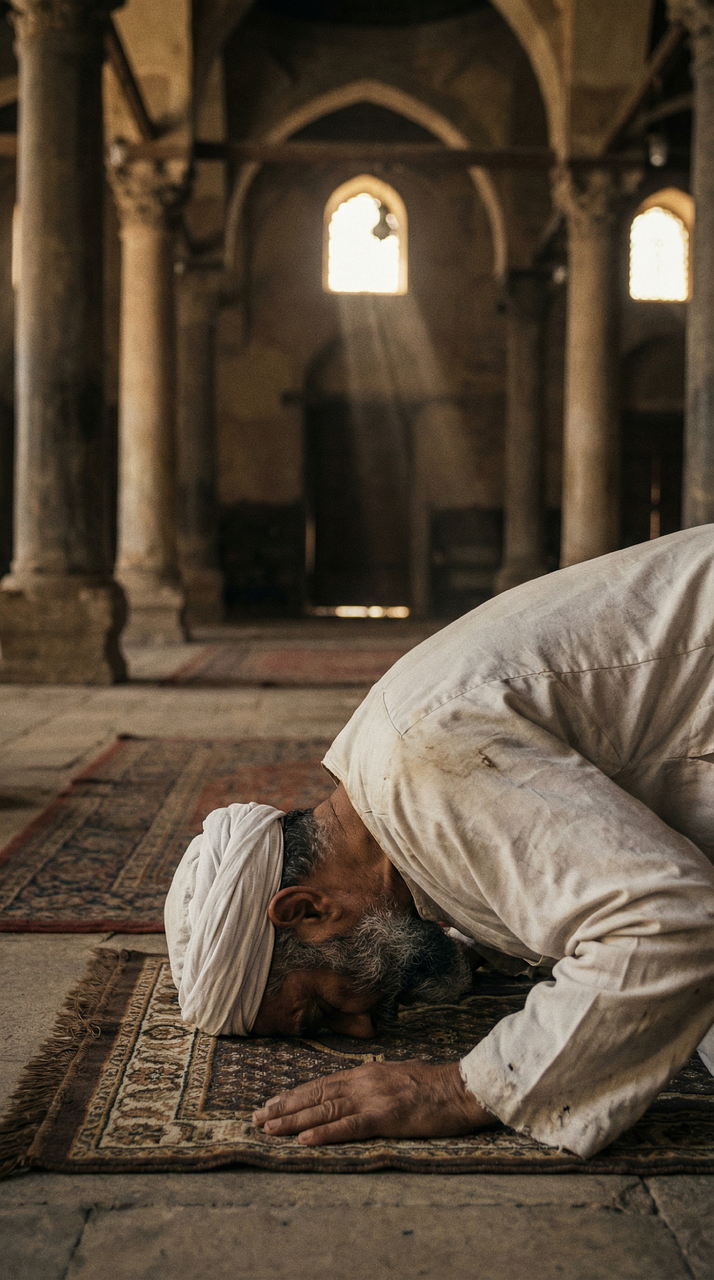
Reflection One
Pray Anyways
On showing up for salah even when the feeling has gone quiet.
When you won't feel like praying — still pray. When you don't feel like making wudu — just push yourself to cleanse yourself. When you don't feel like doing the act of worship, the Ruku, the Sujood, the Tashahud — still spread out the prayer mat and stand on it. If you don't feel like reciting the surahs, be quiet, recite them in your head, and act out the steps. Just get through the rakats. Get to the end. Say the salaams.
If you don't want to make the duas — still think about it. Allah knows your heart. Still think about what you want fixed. Push yourself to sit on the mat, just a little more.
There are days when prayer feels effortless, when the call to worship pulls you naturally toward the mat, when every word flows with meaning and every movement feels purposeful. But those days are not every day.
Most days are ordinary. Some days are harder. On those days, the distance between where you sit and where the prayer mat lies feels impossibly far. The wudu feels like an inconvenience. The standing feels like a burden. The words feel empty in your mouth. This is when the real test begins — not the test of your devotion when it's easy, but the test of your commitment when it's hard.
❧
So you push yourself. You don't wait for the feeling to come. You don't wait until you're inspired or moved or spiritually awakened. You simply stand up. You walk to the bathroom. You let the water run over your hands, your face, your arms. The cold shocks you into presence, even if your heart isn't there yet.
You walk to the prayer mat. Maybe your mind is elsewhere — on work, on worries, on the hundred small tasks pulling at your attention. It doesn't matter. You stand anyway. You raise your hands. You bow. You prostrate. Even if the words feel mechanical, even if your focus drifts, even if this prayer feels like nothing more than going through the motions — you complete it.
Faith isn't always a burning flame. Sometimes it's just a pilot light, barely flickering, sustained only by the repetition of showing up. The act itself becomes the devotion. The discipline becomes the love language when the feelings have gone quiet.
You pray not because you feel like it, but because you committed to it. You pray because some part of you knows that consistency builds something that emotion alone cannot. You pray because the you who doesn't feel like praying still needs it — maybe even more than the you who does.
And sometimes, halfway through that reluctant prayer, something shifts. Not always. Not even often. But sometimes, in the middle of a movement you've done a thousand times before, presence arrives uninvited. The words that felt hollow suddenly carry weight. The act that felt empty suddenly fills with meaning.
But even if that moment never comes — even if the entire prayer feels distant and mechanical from beginning to end — you still prayed. You still showed up. You still honored the commitment you made, not to a feeling, but to something greater than feeling.
That is the prayer that counts most. The one you didn't want to do, but did anyway. Pray anyways.
Reflection Two
Making Duas
On how you approach supplication — and why it matters.
What Is Dua?
Dua (Arabic: دعاء) is the Islamic act of supplication — a direct, personal, and informal conversation with Allah to ask for help, mercy, forgiveness, or blessings. It is considered an essential, heartfelt act of worship that can be performed anywhere and at any time, distinguishing it from the formal, prescribed prayer of Salah.
How Do You Make Your Duas?
Duas are a powerful way to connect with Allah, and how you approach this sacred act can shape your experience significantly. Do you make your duas by begging and pleading, fully aware that you are seeking the Mercy of Allah? Picture yourself standing before your Creator, feeling the absence of barriers that might separate you from Him.
When you make a dua, do you truly believe that He hears you? That He sees you and is watching closely as you lay bare your wants and needs? This moment is deeply personal, and sharing your thoughts and desires with Allah requires an immense level of trust.
Do you have faith that He will respond to your heartfelt supplications? Consider whether you are convinced that what you are asking for will be granted, especially if it leads to goodness in your life. It's essential to remember that sometimes, what we desire may not align with what is truly best for us.
If your request doesn't serve your highest good, Allah, in His infinite wisdom, may offer something even greater — something beyond your imagination.
❧
Four Things to Remember
First
Do not forget to say Alhamdulillah. This simple yet powerful phrase is a reminder to express our gratitude for all that we have. Acknowledging Allah's infinite mercy, even in moments of disobedience, allows us to reflect on His kindness and generosity. Every breath, every moment, and every blessing is a gift from Him.
Second
Make it a habit to say Astaghfirullah. Seeking forgiveness for our daily sins — whether we are aware of them or not — is crucial in our journey of faith. We all make mistakes, but by acknowledging them and asking for forgiveness, we open the door for renewal and growth.
Third
Remember, Allahu Akbar. He is the Creator of the universe and possesses the power to do anything. Recognizing His greatness reinforces our faith and reminds us of the limitless possibilities that exist when we place our trust in Him.
Fourth
Do not be shy when asking for your wants and needs. There is nothing impossible for Allah. When we approach Him with our hearts open and our requests laid bare, we welcome His support in our lives. He knows our desires and needs, and He is always willing to listen.
As we make our duas, let's make a conscious effort to remember these phrases and the profound meanings behind them. They serve as powerful reminders of our faith and encourage us to live with gratitude, humility, and courage. Embrace each day with a heart full of thanks, ready to seek forgiveness, and confident in the greatness of Allah.
Reflection Three
When You Don't Know What to Be Thankful For
On finding gratitude when life feels like a lengthy list of complaints.
Is there a time when you feel you don't know what to be thankful for? Life can sometimes feel like a lengthy list of complaints, where everything seems to be going wrong. Perhaps your mind is telling you that you're in constant pain and there's no purpose to keep moving forward. You may feel like there's nothing to look forward to, and wonder what is even right in your life.
Things to Think About
-
1
Your Health. Do you have your health? Are you able to get out of bed every day and engage in your daily activities? Consider the simple tasks you accomplish — brushing your teeth, bathing, getting ready for work or school. These are all signs of independence and health.
-
2
Work and Purpose. Do you have a job or school to attend? A place that allows you to utilize your skills and earn money to support yourself? Think about how this work may help support your family as well.
-
3
Family and Friends. Are you part of a family that cares for you? Are your loved ones healthy? Do you have a safe space to return to after a long day? Do you have someone to talk to about your thoughts and worries?
-
4
Basic Necessities. Consider your living conditions. Do you have food on your table? Are you able to prepare meals in a clean kitchen? Do you have a space to eat and a restroom for personal hygiene?
-
5
Comfort and Safety. Do you have a place to sleep, a refuge to retreat to when you're tired? Is your home located in a safe neighborhood? Can you rest peacefully at night, free from fears of danger?
-
6
Opportunities for Adventure. Are you able to take vacations and visit new places that rejuvenate your spirit? Do you have the means of transportation to travel and explore the world around you?
Gratitude can often be found in the simplest of things. When you start to list what you have, you may discover things to appreciate that are often overlooked. Acknowledging these aspects of your life can reignite a sense of purpose and fulfillment, even during difficult times. Next time you feel lost in your complaints, take a moment to reflect on these questions and see if gratitude begins to fill the spaces of despair.
Reflection Four
What If We Never Existed?
A reflection on existence, purpose, and faith.
Na tha kuchh to Khuda tha, kuchh na hota to Khuda hota,
Duboya mujh ko hone ne, na hota main to kya hota?
When there was nothing, God was there; if there were nothing, God would be there. My existence has ruined me — if I were not, what would I have been?
— Mirza Ghalib
The Question That Stops Us in Our Tracks
Some questions are too large for ordinary conversation. They surface quietly — in the stillness of the night, in the middle of an illness, in a moment when life feels heavier than we can bear. The 19th-century poet Mirza Ghalib was no stranger to such moments, and in this single couplet, he managed to capture what most of us can barely put into words.
He begins with Allah. Before creation, before time, before anything at all — Allah was there. And if everything were taken away, Allah would remain. This is not simply a poetic flourish. It is one of the most grounding truths a believer can hold onto: that Allah's existence depends on nothing, while everything else depends entirely on Him. Huwal Awwalu wal Akhiru — He is the First and the Last.
Then Ghalib turns to himself, and the tone shifts. "My existence has ruined me," he says. Rather than reading it as despair, we can read it as honesty — the kind of raw, searching honesty that can actually bring a person closer to Allah, if they let it.
What If We Had Never Been Created?
We believe that Allah created us with a singular and profound purpose: to worship Him. Not worship as a mechanical set of rituals, but as a conscious, willing orientation of the entire self toward the One who gave us life.
"Wa ma khalaqtul jinna wal insa illa liya'budoon" — "I did not create jinn and mankind except to worship Me."
— Qur'an 51:56
Without our existence, that relationship would simply not be. The concepts of mercy and forgiveness would have no one to reach. The beautiful names of Allah — Al-Rahman, Al-Rahim, Al-Ghaffar — would have no creation through which they are expressed and witnessed. Our existence is not incidental. It is the very stage on which the mercy, justice, and love of Allah are made manifest.
When Life Feels Like Too Much
And yet — life is hard. Ghalib was not wrong about that. Existence brings with it illness, loss, confusion, and seasons where we cannot see the way forward. There are moments when we have done everything in our power — consulted doctors, sought advice, made du'a after du'a — and still find ourselves waiting, uncertain, and tired.
In those moments, it is easy to feel alone. But this is precisely where faith offers something the world cannot: the certainty that we are not abandoned. Allah is not absent in the silence. He is the One who hears what no one else can hear, who sees what no one else sees, and who is closer to us than our own jugular vein.
"Wa nahnu aqrabu ilayhi min hablil wareed."
— Qur'an 50:16
Hardship, in the Islamic understanding, is never meaningless. It can be a purification, a redirection, or a deepening — a way of stripping away our reliance on the world so that we turn, more completely, to the only One who never fails. The waiting itself can be an act of worship, if we carry it with patience and trust.
Embracing the Purpose Behind Our Existence
Once we accept that our existence is intentional — that we were created, not by accident, but by a Creator who is All-Knowing and All-Wise — it changes how we move through life. It means that even our struggles have a context. Even our doubts, when we bring them honestly to Allah, are part of the journey.
The Prophet Muhammad ﷺ, whose example we follow, lived a life that included immense difficulty. His path was not ease — it was purpose, patience, and unshakeable trust in Allah. Following his ﷺ example does not mean pretending life is easy. It means choosing, again and again, to orient ourselves toward what is real and lasting, rather than what is temporary and distracting.
Ghalib asked, "If I were not, what would I have been?" The Islamic answer, gently offered, is this: you would not have been at all. You would have missed the chance to know your Creator, to be forgiven, to love, to grow, and to return home. Non-existence holds none of that.
A Closing Reflection
Life is, as Ghalib understood, a paradox. It gives and it takes. It raises questions it does not always answer. But for a believer, the questions themselves are not a reason for despair — they are an invitation to go deeper, to seek with sincerity, and to trust the One who holds all the answers we cannot yet see.
May Allah make our existence a source of goodness, grant us clarity in uncertainty, and reunite us — in the best of company — in Jannah. Ameen.
"And He is with you wherever you are."
— Qur'an 57:4
Reflection Five
When in Trouble — Do Not Forget to Ask Allah
On the habit of turning to everything else first, and learning — slowly, consciously — to turn to Him.
Yesterday the alarm blared and I panicked. My heart raced. My mind immediately ran to the people around me — what were they thinking? What must they be assuming? I looked for someone to explain to, someone to calm me down, someone to make the moment smaller. I went through the whole experience in a state of pure human scramble.
It was only later, sitting quietly, that I realised: I had not once thought of Allah.
Not once. Not in the moment of fright, not in the aftermath, not even in the walk back to my floor when the adrenaline was still running. He did not cross my mind. And when that realisation settled, it stayed with me longer than the alarm had. It was more uncomfortable than the panic itself.
We say Allah is first. But when something goes wrong, we reach for everything else first — the phone, the person nearest to us, the explanation, the fix. He is last. Or sometimes, not at all.
And it isn't only alarms. It's the headache that sends me straight to the medicine cabinet before a single dua has been made. It's the difficult conversation I prepare for endlessly, rehearsing what I'll say, without once asking Allah to guide my words. It's the anxious night spent turning a problem over and over in my mind — as if thinking about it hard enough will solve what only He can solve.
The pattern is the same every time. Something happens. I react. I manage. I cope. And somewhere at the end of all that managing, if I remember, I might bring it to Allah. As an afterthought. As a last resort. As the thing I turn to when everything else has already been tried.
I don't think I'm alone in this. I think many of us have built an entire infrastructure of coping that runs on autopilot — and Allah is not in the automatic part. He is the place we arrive at after the automatic has been exhausted. And something about that needs to change.
❧
Think of Allah in Your Good
There is an instruction embedded in the Quran and the Sunnah that I keep coming back to: remember Allah often. Not just in crisis. Not only when you need something. Often. Consistently. As a practice woven through the ordinary hours of the ordinary day.
This means that when something good happens — a kind word from a colleague, a walk that felt peaceful, a meal that tasted right, a moment where everything was fine — the response is gratitude directed somewhere. Not just a vague sense of relief, but an actual turning of the heart. Alhamdulillah. This came from You. This is because of You. I don't take this for granted.
The coworker who was leaving said something to me that made me smile all day. It was unexpected. It landed in exactly the place I needed it to land. My instinct was to feel warm about it, to replay it, to carry it quietly. And it was good to feel that. But I want to learn to feel it one layer deeper — to recognise that the kindness someone extended to me was ultimately sent through them, by Him.
When Something Good Happens
Stop. Even just for a breath. Say Alhamdulillah — and mean it. Not the automatic one that slides out of the mouth like punctuation. The one where you actually pause and acknowledge: this was a gift. I did not earn this. He gave it. Thank Him for it before the moment moves on and the gratitude evaporates into the busyness of the rest of the day.
The Prophet ﷺ said that Allah is pleased with the servant who, upon eating a morsel of food or drinking a sip of water, says Alhamdulillah. A morsel. A sip. The bar for gratitude was never meant to be high — it was always meant to be constant. Gratitude is not the response to the extraordinary. It is the texture of a life lived in awareness of where everything comes from.
❧
Think of Allah in Your Bad
The headache arrives. The first thing I do is reach for the medicine. There is nothing wrong with medicine — it is itself a mercy He created and placed in the world. But the sequence matters. The reaching for the pill before a single word has been directed at the One who made this body and can heal it — that sequence tells you something about where your mind really lives.
What I want to practice is a different reflex. Something frightens me — and before the panic fully takes hold, before I reach for a person or a solution or a distraction — I want my first movement to be inward. Ya Allah. Two words. Sometimes that is everything. A recognition that He is present, that He sees what is happening, that I am not navigating this without Him.
When the alarm went off and I stood there, embarrassed and afraid — what if my first thought had been Ḥasbunā Allāhu wa niʿma al-wakīl? Not because it would have made the alarm stop, or changed what the woman near me was thinking, but because it would have grounded me in something real in the middle of what felt like chaos. It would have placed me, even for a moment, in His hands instead of in the frantic management of appearances.
Reach out to Him. Plead to Him. Let the bad thing — the fear, the pain, the waiting, the not-knowing — become a reason to go to Him rather than a reason to feel abandoned by Him. Let it crack you open in the right direction.
There is a profound teaching in Islam that hardship, when approached with the right orientation, does not push us away from Allah — it brings us closer. Every difficulty that causes a believer to turn toward Allah in supplication is, in some sense, a mercy in disguise. It is not the difficulty itself that is the gift. It is what the difficulty makes you do — the turning, the pleading, the crying, the absolute admission that you cannot do this alone.
That moment of admitting you cannot do it alone is the beginning of something. It is perhaps the most honest moment available to a human being. And Allah loves that honesty. He is Al-Mujeeb — the One who responds. He does not turn away the one who comes to Him with need written across their face.
When Something Hard Happens
Before the phone. Before the medicine. Before the person you would normally call. Try two words first: Ya Allah. Then say what happened. Say what you're feeling. Say what you need. He already knows — but the saying of it matters. It is how you position yourself in relation to Him. It is how you practice making Him first, instead of last.
And if you forgot to go to Him first — if, like me, you only remembered after the fact — go to Him then. The door is not closed because you came late. He does not penalise you for the delay. He simply welcomes you when you arrive. Go anyway.
❧
Let Your Pain Become Your Prayer
One of the things that has stayed with me is the idea that the pain itself can become the substance of the dua. You don't have to arrive at Allah with composed, articulate sentences. You don't have to have the right words, the right posture, the right level of certainty about what you're asking for. You can arrive with the exact shape of the hurt and say: this. I don't even know what I'm asking. I just know I need You here.
The scholars speak of crying to Allah as one of the most beloved states a servant can be in. Not because Allah wants us to suffer, but because the tears are evidence of something: a heart that knows its need, that has stopped pretending it is sufficient on its own, that has softened enough to feel. A heart that cries to Allah is a heart that is still turned toward Him — and that orientation is everything.
So let the headache be a dua. Let the alarm be a dua. Let the uncertainty about next week — whether they will let me work from home, whether the decision will go the way I am hoping — let that be a dua too. Not a complaint lodged at the universe, but a conversation held with the One who is already writing the answer.
Ask for more forgiveness. Let the bad moment make you cry to Him — not away from Him. Let the pain be the reason you open your hands, not the reason you close them. He is closest to the heart that is cracked open in His direction.
❧
The Conscious Practice
This will not happen on its own. The habit of turning to Allah first — in the good and in the bad — is not instinctive, at least not for most of us. It is built. It is chosen, deliberately, again and again, until it becomes the groove the mind naturally falls into.
The work is simple to describe and genuinely hard to do: in any circumstance, any at all — pause, and think of Allah. Not after everything else has been tried. Not at the end of the day during the last prayer. In the moment. Before the reflex of reaching for the human solution kicks in.
-
1
Something good happens. Before you tell anyone. Before you reach for your phone. Say Alhamdulillah and mean it. Let the gratitude find its proper address first.
-
2
Something frightening happens. Before the panic takes full hold. Even if just for a breath. Say Ḥasbunā Allāhu wa niʿma al-wakīl — Allah is sufficient for me, and He is the best Disposer of affairs. Say it and mean it even a little, even while the fear is still present.
-
3
Something hurts. The headache, the sadness, the waiting that has no end in sight yet. Go to Allah with the exact weight of it. Don't dress it up. Don't make it more articulate than it is. Come with the raw thing and put it at His feet.
-
4
You forgot. You went through the whole experience without once thinking of Him. Don't compound it with guilt that keeps you away. Simply go to Him now, from wherever you are, and tell Him what happened. He was there anyway. He was watching. He does not need you to pretend you remembered when you didn't.
The goal is not perfection. The goal is direction. The goal is that over time, slowly, with intention and with failure and with trying again — He becomes the default. Not the last resort. Not the emergency contact. The first one.
That is the practice. That is what I am working on. That is what I think most of us, if we are honest, are working on too.
"And when My servants ask you about Me — I am near. I respond to the call of the one who calls, when they call upon Me."
— Qur'an 2:186