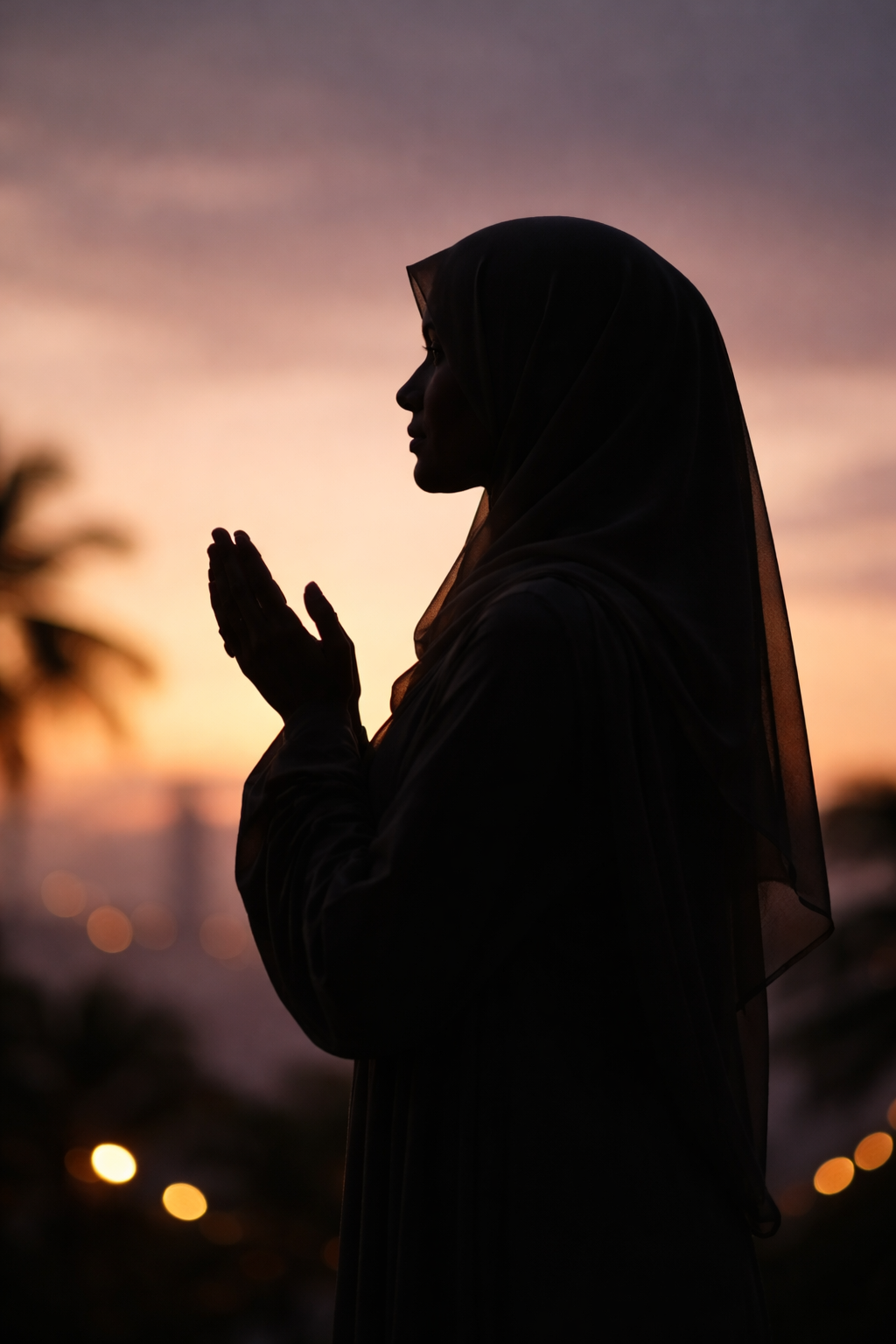
Witr Prayer
The odd-numbered prayer that seals the night — the most confirmed voluntary prayer in all of Islam, and the one the Prophet ﷺ never abandoned in travel or at home.
"Indeed, Allah is Witr (Odd) and He loves the odd number, so pray Witr, O people of the Qur'an."
Ṣaḥīḥ Abū Dāwūd — Narrated by Abū Ayyūb al-Anṣārī (RA)Witr is a word that means odd — a single unit left over after all pairs are counted. It is the prayer that closes the night, the last words of the day spoken in the presence of Allah before sleep, and the du'ā that rises to the heavens at the time when the Lord descends to the lowest heaven, asking who among His servants is calling.
It is one of the most deeply personal prayers in Islam — prayed alone, in the quiet of the night, with no prescribed community, no Friday obligation, and no fixed length. It is entirely between the servant and his Lord, and its form is left deliberately flexible so that every believer can meet it at the level they are capable of.
"The Prophet ﷺ used to pray Witr with one rak'ah at the end of the night."
Ṣaḥīḥ Muslim — Narrated by ʿĀ'ishah (RA)The Ruling — Wājib or Sunnah?
The scholars of the four major schools hold different positions on the precise legal ruling of Witr — all agree it is among the most important non-Farḍ prayers.
| School | Ruling | Evidence & Position |
|---|---|---|
| Ḥanafī | Wājib | Witr is obligatory — not as obligatory as the five Farḍ prayers, but above Sunnah. Abandoning it without excuse is a sin. Evidence: the Prophet ﷺ said "Witr is a duty upon every Muslim" (Abū Dāwūd). Prayed as 3 rak'āt with one taslīm, no break. |
| Mālikī | Sunnah Muʾakkadah | A confirmed Sunnah — one of the most important. Abandoning it habitually is blameworthy. Considered 1 rak'ah after any even number. The single rak'ah alone is valid. |
| Shāfiʿī | Sunnah Muʾakkadah | Strongly confirmed Sunnah. Minimum is 1 rak'ah. Whoever abandons it habitually is to be rebuked and his testimony rejected (indicating its great weight). Prayed with a gap (taslīm) between even rak'āt and the final witr. |
| Ḥanbalī | Sunnah Muʾakkadah | Confirmed Sunnah. Minimum: 1 rak'ah. Recommended: 11 rak'āt. The most virtuous form is 11 rak'āt prayed as pairs with 1 final witr rak'ah. |
"Witr is a right — so whoever wishes may pray five, and whoever wishes may pray three, and whoever wishes may pray one."
Sunan al-Nasā'ī — Narrated by Abū Ayyūb al-Anṣārī (RA) — ṢaḥīḥDespite the scholarly differences over the precise ruling, all four schools agree on a profound practical reality: the Witr prayer should not be abandoned. The Prophet ﷺ never abandoned it — whether at home, in battle, or on the road — and he commanded his companions to guard it. The difference between the madhāhib is one of technical classification, not of practical importance.
The Time of Witr
Witr enters with Isha and exits at the first light of dawn — but within that window, not all times are equal.
"Make Witr your last prayer of the night."
Ṣaḥīḥ al-Bukhārī & Muslim — Narrated by Ibn ʿUmar (RA)When to Pray It — A Practical Guide
If you are confident you will wake before Fajr: delay Witr to the last third of the night. Pray Tahajjud first (as pairs of 2 rak'āt), then seal with Witr. This is the most virtuous sequence and the established Sunnah of the Prophet ﷺ.
If you fear you will not wake: pray Witr immediately after Isha and its Sunnah, before sleeping. The Prophet ﷺ said: "Whoever fears he will not rise at the end of the night, let him pray Witr at the beginning of it. And whoever hopes to rise at the end of the night, let him pray Witr at the end of it — for the prayer at the end of the night is witnessed and that is better." (Muslim)
"In the last third of every night, our Lord, the Blessed, the Superior, descends to the nearest heaven and says: Is there anyone to invoke Me, that I may respond? Is there anyone to ask Me, that I may grant? Is there anyone to seek My forgiveness, that I may forgive?"
Ṣaḥīḥ al-Bukhārī & MuslimThe Number of Rak'āt
Witr is flexible — valid from 1 to 11 rak'āt. All odd numbers within this range are established from the Sunnah.
How to Pray Witr — Step by Step
A complete walkthrough of the Witr prayer for each number of rak'āt, with all actions, recitations, and positions explained.
Make the intention in the heart before beginning: "I intend to pray Witr for Allah." State the number of rak'āt you intend if it helps you be clear. No verbal pronouncement of niyyah is required — the intention is entirely in the heart.
Raise hands to earlobes, palms toward Qiblah. Say Allāhu Akbar and place right hand over left on the chest. You have now entered the prayer.
Recited silently in the first rak'ah only, before Ta'awwudh. This is Sunnah Muʾakkadah.
Obligatory in every single rak'ah of Witr. Followed by Āmīn. Recitation in Witr is always silent (Sirr) — unlike the Farḍ Fajr and Maghrib prayers. However, many scholars permit reciting aloud in Witr when praying alone at night, as the Prophet ﷺ sometimes did.
In every rak'ah, recite a sūrah or portion of Qur'an after Al-Fātiḥah. The specific recommended recitations are detailed in the Recitation section. For the final (Witr) rak'ah: recite Al-Ikhlāṣ, Al-Falaq, and An-Nās after Al-Fātiḥah.
Say Allāhu Akbar going into the bow. Back flat, hands on knees. Say the above dhikr minimum once, sunnah three times. Be completely still before rising.
Rise fully upright, stand still. Then proceed to sujūd.
Go into first sujūd: all seven bones on the ground, elbows raised. Recite Subḥāna Rabbiyal-A'lā (min. once, sunnah three times). Rise saying Allāhu Akbar. Sit briefly, say Rabbighfir lī. Then second sujūd with the same recitation.
In the final rak'ah of Witr (whether praying 1, 3, 5, 7, or 11), Du'ā al-Qunūt is recited. Position: After the rukū' (Ḥanafī: before rukū'). Raise both hands to shoulder level, and recite the Qunūt du'ā. Full text and all forms are in the Qunūt section below.
After the final rak'ah's second sujūd, sit in tawarruk (left foot tucked under right). Recite the full Tashahhud, then the Ṣalāt Ibrāhīmiyyah (Durūd), then the du'ā seeking refuge from four things, then any personal du'ā.
Turn head to the right, then to the left. The Witr prayer is complete. The night prayer is sealed. Now make du'ā, do your adhkār, and sleep — if you have not already prayed Tahajjud.
1 Rak'ah Witr
The absolute minimum — valid, established, and sufficient for when time is short or energy is low.
+ Qunūt
+ Taslīm
Make niyyah for 1 rak'ah of Witr. Pray it as a full, complete rak'ah — Fātiḥah, sūrah (recommended: Al-Ikhlāṣ, Al-Falaq, An-Nās together), rukū', sujūd, and final sitting with full tashahhud and durūd. Recite Du'ā al-Qunūt after rising from rukū'. Give taslīm.
"Witr is one rak'ah at the end of the night."
Ṣaḥīḥ Muslim — Narrated by ʿĀ'ishah (RA)3 Rak'āt Witr
The most widely practised form — two methods are established from the Sunnah.
Method 1 — Two Salāms (Shāfiʿī & Ḥanbalī)
+ Taslīm
+ Qunūt
+ Taslīm
Pray 2 rak'āt as a normal voluntary prayer — Fātiḥah, sūrah, rukū', two sujūds, final tashahhud, taslīm. Then stand separately and pray 1 final rak'ah (the Witr) with Qunūt after rukū', final tashahhud, and taslīm. This is the method of the majority and is the most reliable.
"The night prayer is in pairs — so when one of you fears the morning has come, let him pray one rak'ah and that will make what he has already prayed odd."
Ṣaḥīḥ al-Bukhārī & Muslim — Narrated by Ibn ʿUmar (RA)Method 2 — One Salām (Ḥanafī)
(no taslīm)
+ Qunūt
+ Taslīm
Pray all 3 rak'āt continuously with a single taslīm at the end. Sit for tashahhud after the 2nd rak'ah (reading only up to the shahādah — no durūd), then rise for the 3rd. Recite Qunūt in the 3rd (before rukū' according to Ḥanafī), complete, then full final tashahhud and taslīm.
Important: Do not make this resemble Maghrib by reciting the full tashahhud including durūd in the middle sitting. The Ḥanafī method shortens the middle sitting deliberately.
5 Rak'āt Witr
Prayed as one continuous unit — one taslīm at the very end.
+ Qunūt
+ Taslīm
Pray all 5 rak'āt continuously. Do not sit for tashahhud after the 2nd or 4th rak'ah. Sit only at the end of the 5th rak'ah for the final tashahhud. Recite Qunūt in the 5th rak'ah (after rukū'). Give taslīm once at the end.
7 Rak'āt Witr
Prayed continuously with a mid-prayer sitting in the 6th rak'ah.
(tashahhud
no taslīm)
+ Qunūt
+ Taslīm
Pray 7 rak'āt continuously. Sit for tashahhud after the 6th rak'ah — recite only the tashahhud (no durūd) and do not give taslīm. Rise for the 7th rak'ah. Recite Qunūt in the 7th. Final sitting with full tashahhud and durūd. Taslīm once.
11 Rak'āt Witr — The Complete Night Prayer
The fullest and most beloved form — 8 rak'āt of Tahajjud prayed in pairs, followed by 3 Witr.
+ Taslīm
+ Taslīm
+ Taslīm
+ Taslīm
+ Qunūt
+ Taslīm
Pray 8 rak'āt as 4 pairs of 2, each pair ending with its own taslīm — these are the Tahajjud rak'āt. After completing all 8, pray 3 Witr. The 3 Witr may be prayed with one taslīm (Ḥanafī) or as 2+1 with two taslīms (majority). Recite Qunūt in the final Witr rak'ah.
"The Prophet ﷺ used to pray at night thirteen rak'āt including Witr and the two rak'āt of Fajr Sunnah."
Ṣaḥīḥ Muslim — Narrated by ʿĀ'ishah (RA)This is the Sunnah of the Prophet ﷺ on most nights. ʿĀ'ishah (RA) described his prayer as: he would pray 4 rak'āt of such beauty and length that one cannot describe them. Then 4 more of the same. Then he would pray 3 Witr. Then lie down until the muezzin called for Fajr.
Recommended Recitation in Witr
The Prophet ﷺ established specific sūrahs for the Witr prayer — especially for the 3 rak'āt form.
| Rak'ah | Arabic Name | Sūrah Name | Note |
|---|---|---|---|
| 1st Rak'ah | سَبِّحِ اسْمَ رَبِّكَ الأَعْلَى | Sūrah Al-A'lā (87) | After Fātiḥah |
| 2nd Rak'ah | قُلْ يَا أَيُّهَا الْكَافِرُونَ | Sūrah Al-Kāfirūn (109) | After Fātiḥah |
| 3rd Rak'ah (Witr) | قُلْ هُوَ اللَّهُ أَحَدٌ | Sūrah Al-Ikhlāṣ (112) | After Fātiḥah — plus Al-Falaq & An-Nās optionally |
"The Prophet ﷺ used to recite in Witr: 'Sabbihisma Rabbikal-A'lā' in the first rak'ah, 'Qul yā ayyuhal-kāfirūn' in the second, and 'Qul Huwallāhu Aḥad' in the third — and after it Al-Falaq and An-Nās."
Sunan Abī Dāwūd, Tirmidhī, Nasā'ī — ṢaḥīḥFor Other Numbers of Rak'āt
For 5, 7, or 11 rak'āt Witr, there is no specific narration fixing which sūrahs to read in each rak'ah except the final three. Follow the established Sunnah for the last three rak'āt (Al-A'lā, Al-Kāfirūn, Al-Ikhlāṣ) and recite any sūrahs of choice in the earlier rak'āt. Longer sūrahs in earlier rak'āt are consistent with the spirit of the night prayer.
Du'ā al-Qunūt — Complete Text
The supplication of Witr, taught by the Prophet ﷺ to al-Ḥasan ibn ʿAlī (RA), recited standing in the final rak'ah.
This du'ā is the most authentically established Qunūt text — narrated by al-Ḥasan ibn ʿAlī (RA) who said the Prophet ﷺ personally taught it to him for the Witr prayer. Every sentence of it is a complete act of tawakkul and surrender: asking for guidance as part of the guided, safety as part of the protected, and blessing in whatever has been given — not asking for more, but asking for barakah in what already exists.
Additional Qunūt Supplications
Further authenticated du'ās that may be added after or combined with the primary Qunūt — expanding the supplication.
It is Sunnah to send ṣalāt upon the Prophet ﷺ at the end of the Qunūt, just as it is at the end of every du'ā. This is added after the primary Qunūt text.
Narrated from ʿUmar ibn al-Khaṭṭāb (RA) — used in congregational Witr during Ramaḍān. Considered authentic by scholars including al-Bayhaqī. May be added after the primary Qunūt.
After the transmitted du'ās, it is permitted and encouraged to add personal supplications in any language during the Qunūt standing. The Qunūt is a moment of standing before Allah with hands raised — it is not limited to memorised text. Ask for your family, for your affairs, for the Ummah, for the dead, for guidance. Allah is listening.
"Du'ā is the very essence of worship."
Sunan al-Tirmidhī — Narrated by al-Nu'mān ibn Bashīr (RA) — ṢaḥīḥWhen & How to Recite Qunūt
The scholars have detailed the exact position, posture, and conditions for Du'ā al-Qunūt in Witr.
Position — Before or After Rukū'?
Posture During Qunūt
Is Qunūt Obligatory in Every Witr?
Ḥanafī: Yes — Qunūt is Wājib in Witr throughout the year. Omitting it without prostration of forgetfulness is an error. Majority: Sunnah, not obligatory — the prayer remains valid if Qunūt is omitted, though a prostration of forgetfulness is recommended. Both agree it should not be abandoned habitually.
Making Up a Missed Witr
What to do if Witr is missed due to sleep or forgetfulness.
"Whoever sleeps through Witr or forgets it, let him pray it when he remembers or wakes up."
Sunan Abī Dāwūd, Tirmidhī — Ṣaḥīḥ — Narrated by Abū Saʿīd al-Khudrī (RA)If Witr is missed, it is to be made up as soon as one remembers — either in the night (before Fajr if still possible) or after Fajr has been prayed. The makeup Witr is prayed during the day as Shaf' and Witr: pray an even number first (e.g. 2 rak'āt), then 1 Witr — to maintain the principle of making the night prayer odd.
The Prophet ﷺ once missed his night prayer and made it up during the day between Fajr and Dhuhr — praying 12 rak'āt. This establishes that making up missed Qiyām al-Layl, including Witr, is both valid and recommended rather than simply abandoning it.
Witr While Travelling
The Witr prayer is not shortened during travel — it is maintained in full.
"The Prophet ﷺ used to pray Witr while on his mount, making the camel walk in whichever direction it went."
Ṣaḥīḥ al-Bukhārī & Muslim — Narrated by ʿĀ'ishah (RA)While the five Farḍ prayers are shortened during travel (4 rak'āt become 2), Witr is not subject to this reduction. It remains as many rak'āt as one intends to pray — minimum 1, up to 11. The Prophet ﷺ maintained Witr in all circumstances: "The Prophet ﷺ never abandoned Witr whether on a journey or otherwise." (Narrated by Abū Hurayrah — Aḥmad)
Voluntary prayers that have no fixed direction (such as praying while in a vehicle or on an animal) are permitted during travel — pointing in the direction of travel. Witr may be performed this way when it is genuinely difficult to stop and face the Qiblah.
Virtues, Facts & Wisdoms of Witr
What the Prophet ﷺ said about this prayer — and what it means.
Sources & References
All narrations, rulings, and details in this guide are drawn from the following primary classical sources.
Ṣaḥīḥ al-Bukhārī — Kitāb al-Witr; Kitāb al-Tahajjud. Primary source for the time, number, and abandonment policy of Witr.
Ṣaḥīḥ Muslim — Kitāb Ṣalāt al-Musāfirīn. Narrations of ʿĀ'ishah (RA) describing the Prophet's ﷺ 11 rak'āt and the 1-rak'ah Witr.
Sunan Abī Dāwūd — Kitāb al-Ṣalāh. The narration of al-Ḥasan ibn ʿAlī (RA) on Du'ā al-Qunūt; rulings on making up missed Witr.
Jāmi' al-Tirmidhī — Narrations on the recitation of Witr (Al-A'lā, Al-Kāfirūn, Al-Ikhlāṣ) and the Qunūt text.
Sunan al-Nasā'ī — Kitāb Qiyām al-Layl. The ḥadīth of Abū Ayyūb al-Anṣārī on Witr's flexibility (1, 3, or 5 rak'āt).
Sunan Ibn Mājah — Kitāb Iqāmat al-Ṣalāh. Additional narrations on the structure of Witr.
Ṣifat Ṣalāt al-Nabī ﷺ — Shaykh Muḥammad Nāṣiruddīn al-Albānī. The most thorough modern compilation on Witr from authentic sources. Primary reference for posture details.
Zādul-Maʿād — Ibn al-Qayyim al-Jawziyyah (d. 751H). Chapters on the Prophet's ﷺ Witr and night prayer — detailed descriptions of his ﷺ practice.
Al-Mughnī — Ibn Qudāmah al-Maqdisī (d. 620H). Ḥanbalī rulings on Witr, Qunūt position, and number of rak'āt.
Al-Mabsūṭ — Al-Sarakhsī (d. 490H). Ḥanafī rulings classifying Witr as Wājib.
Al-Umm — Imām al-Shāfiʿī (d. 204H). Shāfiʿī position on Witr as Sunnah Muʾakkadah and the Qunūt after rukū'.
Fiqh al-Sunnah — Sayyid Sābiq. Cross-madhab comparative reference used for summary of scholarly positions.
Where the four madhāhib differ in rulings (particularly on the legal status of Witr and the position of Qunūt), both opinions are presented. Readers are encouraged to follow a qualified scholar in their own tradition, knowing that all four positions are valid, well-evidenced, and honoured in Islamic scholarship.